Showing posts with label Dune Sunflower. Show all posts

Thursday, March 3, 2022

Dune Sunflower - Why Draw

 Dune sunflower, Helianthus debilis, sometimes can be a victim of its own success. It's showy, tough, and flowers enthusiastically year round in frost free areas. A goodly mound of it, with its bright yellow-green leaves, and undiluted yellow ray flowers ringing purple-brown disk florets, brightens up the garden considerably. It wants no pampering. All it asks is space - and there's the rub. 

Space is an increasingly rare commodity in contemporary home sites around here. Lots generally are small, and the houses are built all the way to the 7.5' setback on the sides.( Higher floors sometimes are built all the way out to the property line, curiously reminiscent of medieval street scenes of tall buildings towering over dark, narrow passages). 

The plant is readily available, and some people, municipalities and road authorities have planted it to their chagrin. This is a plant that survives on the pure, sugar sand of Florida's beaches, buffeted by salty coastal winds, and subject to extreme drought while in full sunshine. The average yard, even unfertilized and unirrigated, can be an Eden in comparison, and granted this largesse, the plant takes off.

It doesn't grow as fast as kudzu, but over a period of months a healthy plant will overrun anything in its path, and certainly will outgrow a narrow median strip. Judicious pruning will keep it pretty for a long time. It has to be pruned along the edges, not from the middle, or center. Pruning gets trickier once the  plant has begun to mound over itself. Its long, creeping branches intertwine, so it's pretty impossible to see what belongs to what.

As the plant tumbles over itself, the higher leaves and stems shade out lower levels. A luxuriant-looking mound, may well be completely bare in the middle, with just a veneer of new growth over a scaffolding of aging, woody, leafless stems. It looks atrocious if it is hedged, which is about all most "mow-and go" yard crews know how to do.


Badly "Pruned" Dune Sunflower

This mounding habit makes it particularly attractive in large pots, from which its flowering branches can cascade around it. Eventually the bottom parts of the stem in the pots get woody and bare, which means it's time to cut back hard or pot up another plant. Dune sunflowers transplant easily if they aren't too big. They also root readily and self-sow vigorously if there isn't too much competition. (I wrote more about the dune sunflower in my blog post of Feb. 21, 2021, "January - Not the Greatest New Year.")


All From One Plant, One Pot


 The plant's energetic, uppreaching and semi-vining  habit make it an ideal subject for line drawings. I like drawing better than painting generally. Yellow is a particularly vexing hue for me, because it is so easy to "dirty" it with shading, which destroys its luminance unless you get lucky.


 1-Line Gesture Drawing; Color Study
(Yellow Is Too Light and Greenish)


Part of the definition of line, as it applies to art, is"...an identifiable path created by a point moving in space."("The Elements of Art," J. Paul Getty Museum website: www.getty.edu/for_teachers/building...lessons).

I love this definition because it also seems to denote the action of a growing plant. Attempting to follow that delightful dance of a plant's characteristic energy never fails to engage me.


Dune Sunflower, Pencil Sketch

Drawing is often frustrating and boring, and it requires hours of practice. But succeeding in capturing  movement in the sinuous curve of a stem, or the baroque undulations in a leaf's edge, be it just for an inch, makes all the failed attempts fade into insignificance. I'll never stop trying - and failing -  to get there.

Of course, a line drawing cannot capture the entire being of a plant - in this case, the sandpapery  texture of its leaves, the range of greens and yellows, its volume en masse, even its "non-fragrant" odor. That is a problem of all 2-dimensional media - it can't accomplish everything in one go. But artists and writers of all abilities attempt to capture and communicate something of the innate "truth" of an object or landscape. 


Texture- Dune Sunflower


I looked for answers on "why we draw" on the web, and all I came up with was articles on chemistry -  substances produced by the brain that make us feel pleasure and/or reward. But nothing on why one person is compelled to take pencil to paper while another is driven to put in hours learning to dance, make something, design a building, or throw a ball through a net. Apparently the chemicals are the same, and when you get down to it, they really don't tell us much. And why do some of us want to communicate so badly? It's more than what my husband calls, "teaching your grandmother to suck eggs." It's more like a toddler desperately wanting others to appreciate the wonderfulness of his latest toy. Drawing plants, for me, has something to do with joy, with sharing, with gratitude. But basically, I really can't say.


Sunday, February 21, 2021

January - Not the Greatest New Year

January came and went, and for once, time seemed to drag. Apart from political and COVID misery, the month opened with gray, chilly weather, powdery mildew, and an episode of red tide. Not a great start for a happy new year. 

 Powdery mildew first appears as white, somewhat circular splotches on the top sides of leaves. It looks a little like they have been sprinkled with flour or talc. Yellowing, browning, and death of the leaf may follow.  Powdery mildew, a true fungus, flourishes with  cool nights combined with high humidity and warm days. This time of year we tend to have heavy dewfall, and even fog. If I were growing vegetables this year, I most likely also would be dealing with downy mildew, a socalled "water mold," which likes the same conditions. 

Since crowding, combined with shade and moisture, makes powdery mildew worse, it showed up mainly on large clumps of dune sunflower, Helianthus debilis growing around  some palms and  large shrubs in the front yard, and on the near-prostrate rosettes of Elliott's aster.

I am letting the Elliott's aster deal with the mildew on its own. The rosettes collect moisture every night and early morning. I probably couldn't get it completely eradicated even with a regular spray schedule, and since I avoid pesticides, I'm not spraying it at all. Since this is a recurring event, I expect the asters to grow out of the problem once the drying winds and sunnier days of March roll in.


Powdery Mildew on Elliott's Aster


I pretty much got rid of the mildew on the dune sunflowers by drastic pruning, even removal of entire clumps.

 Left to itself in a garden situation, dune sunflower forms large, mounding clumps, often with dead, decaying, or whitefly-infested branches hidden underneath. Keeping them nice and somewhat contained requires periodic pruning, even cutting back to the ground. The ones I removed didn't have these problems yet. Salt spray and wind keep the plants smaller in their dune habitat. 

The back yard is subject to pitiless sun most of the day,  so powdery mildew rarely pops up there. It was time to do hard pruning of the sunflowers there anyway, just to tidy things up, and remove dead branches. I like to leave "islands" of it so that what snakes and reptiles we still have can move around with some cover. The great egret in particular is a voracious predator of anoles and skinks, and I once saw a hawk pluck a corn snake from the front yard. 

There are 3 subspecies of Helianthus debilis in Florida. My plants, originally obtained from native plant sales, are predominantly the east coast dune sunflower, Helianthus debilis subsp. debilis. The species hasn't been vouchered in Collier County, but I have seen it growing on the dunes. Since walking on the dunes is a serious no-no because it is so destructive,  I can't say for sure what subspecies they are. The plants in our yard are both mounding and somewhat vining. They root easily at the nodes. The leaves are roughly triangular, and shaped like arrowheads with a large base. They have a sandpapery texture. The petioles are long, and the leaf margins vary from entire to noticeably toothed. The stems range in color from green to maroon, and are also somewhat rough to the touch. The sinuous quality of the stems makes the plant fun to draw. 


Helianthus debilis Stem with Opening Head


Flower heads are an intense yellow. Just before the sun sets, they can take on a slightly luminous quality.  The plants are evergreen here, and bloom all year. Butterflies and moths visit them, though they are not favorite nectar  plants. A variety of bees, wasps, and other small pollinators are more common visitors in our yard. Mourning doves like to shelter under them, and no doubt eat the seeds.


Dune Sunflower Habit


Apart from its eagerness to overrun the entire yard, Helianthus debilis is a great garden plant. Its colorful blooms and  bright foliage enliven the yard. Like Gaillardia, a clump of dune sunflower just cheers up the scene. Its semi-vining stems will cascade prettily over the sides of a large pot. The hidden branches of a large, old clump become infested with whitefly and mealy bugs over time. Otherwise I haven't noticed any insect problems, and no disease troubles other than the seasonal mildew. The plant is extremely drought tolerant. I never water it unless it is in a pot.


Helianthus debilis


-----------------------

Officials like to say that red tide is a natural phenomenon. They're right - to an extent. These algal blooms can be caused by an upwelling of nutrients from the ocean floor, triggered by large storms, temperature swings, changes in salinity, and so forth. They normally occur here when the weather is warm - from August to November. 

But red tides have become more persistent in the past 5 or so years, exacerbated by humans. The period from the summer of 2016 through the winter of 2019 was particularly disastrous for southern Florida. Heavy rains forced the Army Corps of Engineers to make record-breaking discharages of fresh water from Lake Okeechobee. The fact that the earthen levee around Okeechobee is obsolete and can't stand the pressure of elevated water levels has been known for decades, but the political will to do anything about it has been lacking. Fresh water itself is a pollutant in brackish and saline ecosystems. Discharges from the lake weren't only fresh water, but fresh fertilizer-laden water. 

Lake Okechobee feeds the Caloosahatchee River on the west coast, and the St. Lucie river on Florida's east coast. Discharges to the west contributed to an existing red tide in the Gulf. "Our" red tide here on the southern Gulf coast is caused by a population explosion of a dinoflagellate called Karenia brevisKarenia brevis can't survive in fresh water, but while the west coast was coping with beaches strewn with dead fish and marine mammals, and more, the east coast sustained equally disastrous consequences due to a nutrient-fed bloom of blue-green algae. Some places, like Sanibel Island, near the mouth of the Caloosahatchee,  got the worst of both worlds. Sanibel even had to deal with a 21-26 foot-long dead whale shark that washed up on one of its beaches. (Reports on the size differ). Florida lost numerous dolphins, sea turtles, and approximately 13% of the manatee population. 

Lake Okechobee feeds the Caloosahatchee River on the west coast, and the St. Lucie river on Florida's east coast. Discharges to the west contributed to an existing red tide in the Gulf. "Our" red tide here on the southern Gulf coast is caused by a population explosion of a dinoflagellate called Karenia brevisKarenia brevis can't survive in fresh water, but while the west coast was coping with beaches strewn with dead fish, dead marine mammals, and more, the east coast sustained equally disasterous consequences due to a nutrient-fed bloom of blue-green algae. Some places, like Sanibel Island, near the mouth of the Caloosahatchee,  got the worst of both worlds. Sanibel even had to deal with a 21-26 foot-long dead whale shark. (Reports on the size differ). Florida lost numerous dolphins, sea turtles, and approximately 13% of the manatee population. 

The state sustained millions of dollars in lost tourist revenue as well as cleanup costs. Fisheries and related business such as marinas, fishing guides and boat rentals also suffered catastrophic losses. With no income tax, Florida depends heavily on tourism revenue and taxes, and the blow was bad enough finally to jolt some political actors awake. It's too bad that it takes a massive pocketbook issue like this to speed up significant corrective activity. One would think that degraded ecosystems and lowered quality of life would be enough.

Karenia brevis produces a neurotoxin that builds up in the food chain. Wind causes it to be aresolized, and many people living near the coast, including me, end up with real respiratory distress from red tides. Some people even need to be hospitalized. It's quite possible that it contributes to the deaths of marine mammals and sea turtles, which all breathe air. This January hundreds of dead fighting conchs washed up on one Marco Island Beach. If you think dead fish smell bad, wait until you get a whiff of rotting mollusks! Our canal turned a nasty reddish-brown color, and the fish, first catfish and mullet, started floating belly-up. 


Red Tide in Our Canal


After a few weeks' absence, red tide is back in the region, if not in our own backyard. The bloom gets blown or carried out by tides into the Gulf. When we get westerly winds it blows back in. This time around it is affecting fish-eating birds such as royal terns, cormorants and pelicans, along with fish, mollusks and sea turtles.

-----------------------------

The cooler weather this fall and winter has given us a bit of seasonal color. Some years the Virginia Creeper stays mostly green, but this year my neighbor's vine, creeping through the slats in our fence, sported lovely reds and violets. It's a pretty vine, even green, but it is too rapacious for most landscapes - especially small ones. Her yard crew pulled it out shortly after I made my sketch, but it will pop up again. 


Virginia Creeper - Parthenocissus quinquefolia


In the meantime, dune sunflower, other seasonal flowers, and visits by migratory birds keep the gloom and doom away. I even saw a leucistic grackle, something I'd never heard about before. The feathers on its head were startling white. I haven't seen it since.


Monday, July 1, 2019

Clean Sweep

I've never managed to keep a  neat garden, and neighbors and walkers tell me they like my flowers. Still, I worry that the subtext is, "Your yard is an unholy mess, but at least it's colorful." Finally, old age, an arm injury still lingering after cleaning up after Irma in 2017, and my general sleaze coalesced into the proverbial "perfect storm" landscape-wise, and I had to hire somebody to clear-cut the mess.


Chaos is the Opposite of a Garden

Phyla nodiflora, "Fogfruit," makes a wonderful flowering natvie ground cover that attracts many pollinators, the lovely white peacock butterfly included. It was invading the driveway, and  had crept, kudzu-like, over a stack of paving blocks, 6 bags of mulch, and a patch of wickedly spiny agave, itself out of control even though I had been attacking it regularly.


Phyla nodiflora - Good Pollinator Plant


Sea purslane, Sesuvium portulacastrum, another desirable native ground cover,  was smothering a pot of lotus and a nice patch of Heliotropium amplexicaule. It also presented a bad tripping hazard for anybody brave enough to make a foray into the "jungle." Thickets of scorpion-tail, scattered scarlet sage, and blue porterweed competed for light. Swaths of gaillardias and mounds of dune sunflower were flopping over onto the neighbor's driveway. The gravel swale, where I had nourished the fond idea of creating a meadow of blue-eyed grass (Sisyrinchium angustifolium), was instead a mess of moisture-loving opportunists. A dead palm tree and deformed Red Geiger, both courtesy of Hurricane Irma, completed the picture of utter surrender.

Even the rosiest of glasses couldn't mask the reality. Desperate times called for desperate measures, and I called a garden center to restore the bare bones of  the landscape. Two truckloads of debris and over a hundred bags of mulch later, we have one of the neatest and most cared-for yard on the street, which has its pluses, but is not exactly my ideal garden.


New Look for the Front Yard


Although the yard hardly is bare, the new space comes with a cost beyond what the garden center charged. For years our yard has been one of the very few landscapes in our neighborhood to offer  significant amenities of pesticide-free shelter, food and water for animals. Now in its rather barren state those amenities, especially the shelter, are much-reduced.

 However, we do not want to return to what it had become, which was by no means a garden. One thing I have learned is that the garden is as much about space as it is about plants. Without space,  there is no focal point, no rest for the eye or the soul. If the garden is neither  pleasant for walking or viewing, it is a failure, regardless of the beauty of individual plants. The very word "garden" signals the imposition of some kind of order. A  "wild garden" is a contradiction in terms.

So now, I have to recreate some of the lost habitat without losing the harmony of the space. As the old plants begin to resurface through the mulch, I have to organize them into well-defined beds, augmented perhaps with potted specimens. The self-discipline to pull out the surplus will be hard for me to maintain, but if I don't, the mess will re-establish itself quickly. That should provide motivation enough, because the yard really had become horrible and impassable.


Pots for Color


Given the fact that the yard is so small, I also need to ensure that the majority of the plants do more than one job. The agaves don't exactly fit that requirement, though dragonflies like to perch on their upright leaves, and pollinators love the flowers when they appear finally. But we both love the sculptural quality of the plants. A Red Geiger volunteer seedling will fill the space left by the agaves, and all will have enough room for the next several years. Though not a native, the Geiger will be a multi-purpose asset, and deserves its own post.

Wish me luck!


Friday, July 13, 2018

Sahara in South Florida?

June did not waste any time coming and going, and we're already pushing mid July.

Though it's been raining about a mile inland, we've been unusually dry here on the coast. The westerly seabreeze from the Gulf is keeping the summer storms from making it to us. According to our rain gauge, we got only 2.39 inches of rain in June, and most of that fell in one enormous thunderstorm. The rest of the rain fell in increments of a few hundredths of an inch, not enough to wet more than the very top layer of sand.

 So far in July, we've had 1.01," with little chancce of more before the end of next week. ( I have to be careful about what I wish for. I was lamenting the drought in May, and we ended up with over 15 inches here at the house). I save as much rainwater as I can, but I have containers for only 40-50 gallons, and I've used it all. I irrigate as little as possible, almost on a triage basis, but if this dry spell lingers too much longer I definitely will have to drag the hose around.


Dune Sunflower, Helianthus debilis, a semi-vining, scrambling beach native.  It takes  major drought to slow it down.


It's hot. Hot and humid, with heat indices in the 100's for most days. The whiteflies are going to town, and it's time to dispose of  expiring tomato and pepper plants. Native plants are far from immune, one reason I pulled out bushels of spent Gaillardias about a month ago. In Florida Weather, Morton D. Winsberg writes, "... air over Florida in summer becomes so humid that conditions are similar to those during rainy season in the Amazon or Congo basins." (p.94). By afternoon in summer our skies typically are hazy, even milky due to the humidity.


The weather may have been keeping me indoors for much of the day, but life in the garden continues at a frantic pace. The Lignum vitae, Guajacum sanctum, completed a glorious flush of blooms the last week of June. The blooming period is short - only about a week - but the intensely blue-to-violet flower petals are so gorgeous that I can't mourn the briefness of their stay. Besides, there will be more flushes as the year progresses.


Lignum vitae, Guajacum sanctum


This very slow-growing tree has shiny evergreen compound leaves and deeply textured grayish bark. It will grow tall and spindly in deep shade, but given more sun, it often develops a somewhat spreading habit. The trunk of the one in our yard is virtually prostrate. It had to grow out instead of up to get the light it craved, and two hurricanes enhanced the lean.  The plant definitely adds to the garden even out of bloom. Birds love to perch in it. The ornamental seed pods remind me of small golden turbans. They open to expose shiny black seeds covered with a fire-engine red flesh which mockingbirds and cardinals relish.


Open Seed Pods and Shiny Red Flesh Covering the Seeds


Since this tree has such a slow growth rate, it's not surprising that the wood is extremely tough. It is so heavy it won't float. The high resin content - about 30% - means that items made from the wood are self-lubricating, and it has been used for centuries, especially in shipping, for bearings and pulleys, and in food-handling machinery to avoid contamination. Gil Nelson writes, "Hinges made from lignum vitae served the locks of the Erie Canal for over 100 years." (The Shrubs and Woody Vines of Florida, p. 371).

 The resin gives it great tensile strength as well. Belaying pins, cricket balls, croquet mallets, British police truncheons, and mortars and pestles are some of the many other items made from this wood. Lignum vitae wood was used for the "aft main strut-bearings for the USS Nautilus," the first nuclear sub in the world. An item of trivia : images of the flowers, which are the state flowers of both Jamaica and the Bahamas, were embroidered in Meghan Markle's wedding veil. (Most of this information is from the Wikipedia article on Lignum vitae).


The discovery of the wood's qualities coupled with the fact that its sap could be used to treat symtoms of syphilis, meant that from the 1500's on, vast quantities were cut and shipped to Europe. This native of tropical America, from roughly northern South America to the Florida Keys, is now endangered. Fortunately it can be grown from seed, and grows well in cultivation. If you ever get the chance to visit Lignum Vitae Key State Botanical Park, don't miss it! Lignum vitae key has one of the very few, perhaps the only, virgin tropical hardwood hammock left in Florida.

Now, back to the Sahara. In spring, summer and early fall, vast clouds of dust from the Sahara desert collect in masses 1-2 miles deep, and 5,000 - 20,000 miles high in the atmosphere. These clouds of dust can be as large as the continental US. The Saharan Air Layer, as it is called consists of hot, very dry dusty air containing much mineral dust, and can be associated with strong winds. It tends to weaken or depress tropical storms, especially tropical cyclones moving across the Atlantic. (article by Jason Dunion. I can't get a direct link to the article to work, but you can find it on the NOAA website. In the search box type "Saharan Air Layer," and it should take you to the article). Because it blocks the sun's rays, it also diminishes local convective thunderstorms, which along with seabreeze collisions are a major source of Florida's summer rain. While the SAL is in place, we can pretty much forget about rain. I don't think the SAL extends much farther north than South Florida in the U.S., but I haven't been able to confirm that yet.

For a fascinating overview of the contents of Saharan dust, and the effects it has on the earth, including fertilizing the Amazon and sequestering carbon in the ocean, read Jason Adetunji's article, "What Dust from the Sahara Does to You and the Planet." (I can't get a link to work for this article either, but it appeared appeared in theconversation.com. You can find the article by entering the title in the search box).


The reddish soil in an agricultural area in Miami-Dade County known as the "Redlands" is possibly the result of tons of deposited Saharan dust, which contains iron particles.


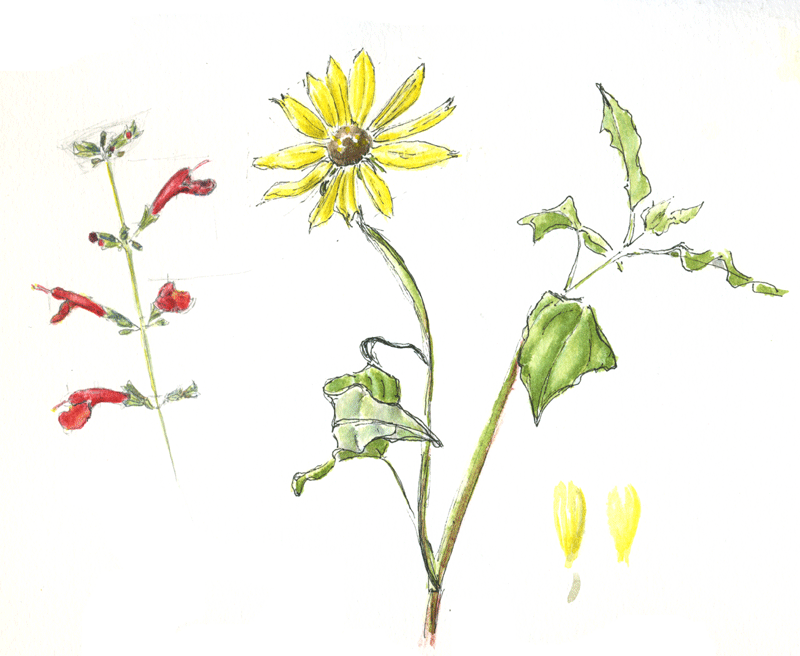
Scarlet Sage and Dune Sunflower