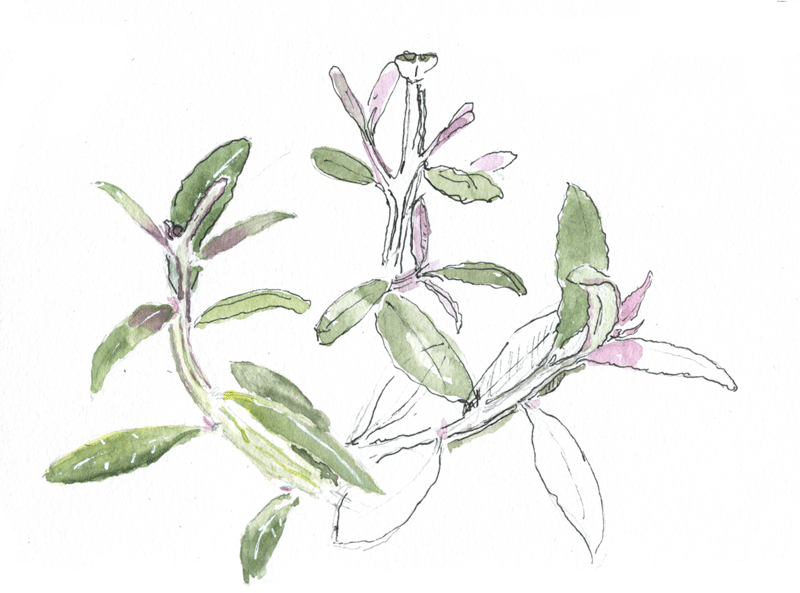
Showing posts with label Nature Sketchbooks. Show all posts

Tuesday, October 12, 2021

Twisted-Banded Airplant

 The twisted-banded airplants (Tillandsia flexuosa Sw.) in our yard bloomed most of the summer, and are producing seeds now. This "airplant" is neither rare nor common in Florida, though I suspect loss of habitat is making in more infrequent. It ranges as far north as central Florida, and southward through the Caribbean, parts of Mexico and Central America, Columbia, Venezuela, and the Guianas. It also is a plant of the lowlands, staying from sea level to about 400 meters in elevation. It is quite salt tolerant, thriving in our yard only a few bits  of barrier islands away from the Gulf of Mexico. Some of the plants mounted on small trees got blown 90 -180 degrees off their axes during Hurricane Irma in 2017, but they gradually grew back toward the light. 


Tillandsia flexuosa and pup

The typical plant could be described as "loosely wrapped," with around 10 -15 stiff, leathery leaves arranged in a loose spiral. After the plant has produced seeds it eventually falls apart. The size and appearance of Tillandsia flexuosa vary dramatically, depending on where the plants are growing. The specimens growing in the harsh scrub of the Naples Preserve or Rookery Bay's upland areas are gray/silver, sometimes with tinges of crimson, with darker gray horizontal bands. 


Young T. flexuosa in Naples Preserve


Those living in more shade are progressively a greener gray/almost white, with darker green horizontal bands. The leaves may recurve rather dramatically or remain more upright. I have observed the greatest degree of recurving in plants in fairly deep shade, and suspect it is the plant's way of seeking more light. The plant produces pups, and over time will form a small colony. Given the behavior of the plants in our yard, it germinates fairly easily as well.


T. flexuosa seedlings on Fiddlewood
Do you see the anole?


The inflorescence, which can grow up to a meter tall, is branched, with flowers on alternate sides of the branches. Each branch ends in a pair of bracts, one  normal-sized and one much smaller and sterile.  The bracts and flowers grow at fairly wide angles to the branches - often near 90 degrees, which gives a slightly zig-zag appearance. I imagine that this, and the slight curvature of the areas between the bracts gives the branch greater strength and stability, since the process of flowering and seed production is fairly long. 


Inflorescence


The flowers are a deep, warm pink, and open over a long period, so the plant produces points of intense color, rather than a large display. Once the seeds have dispersed the insides of the bracts reveal themselves to be a deep, rich maroon, which also is attractive. A flower arranger probably would love the dried inflorescences. 


A non-local variety of the plant is viviparous, meaning that the seed germinates in the fruit before the fruit is detached. The mangrove "pencil" is a good example of vivipary. I have noticed seedlings on the dried branches of the inflorescence, and assumed that they had fallen and been trapped by residual fibers, but obviously I need to observe my plants much more closely next year.  The photo below shows somewhat out-of-focus green seedlings on the right of the inflorescence.


My first plants came from a legal rescue in the Panther Reserve, just north of the Fakahatchee Slough. Several large trees had been felled to make room for a greenhouse for native orchids, and I and fellow members of a botanical identification course visiting for the day were welcomed to harvest the epiphytes. (The trees were going to the shredder). Since then, I've become an active parking-lot stalker, especially where there are old live oak trees. Usually the fallen epiphytes are the ubiquitous ball moss (T. recurvata L) and wisps of Spanish moss(T. usneoides L), but I've found a fair number of the twisted-banded airplants as well. I haven't found that many lately, so maybe the supply has been exhausted.

I occasionally find pot-belly airplants (T. paucifolia Baker)  and Southern needleleaf (T. setaceae Sw) on or under declining shrubs. I don't take any from a healthy host, but if the shrub is definitely headed for the shredder, I will break off dead branchlets and the airplants. I stopped picking once, because I felt greedy, only to notice the next week that all the plants had been uprooted and replaced, so I won't have as many scruples now when it comes to harvesting from dying shrubs in parking lots. 

Our plants thrive in the shade and branches  of a Fiddlewood. It never has flourished, and I fear it eventually will die, but in the meantime it provides a perfect habitat for the Tillandsias and other epiphytes.


For more on Spanish Moss, see my post on April 12, 2019, "Southern Gothic - Spanish Moss."

See also "Parking Lot Potbelly." Feb. 27, 2019.

Wednesday, July 14, 2021

Peeling Bark - An Attractive Feature of Simpson's Stopper

Peeling bark is just one of the many charms of the  Florida native plant, Simpson's Stopper (Myrcianthes fragrans). The specimen in our yard, which I have "limbed up" and trained into a multi-trunked large shrub, is shedding its bark now. It doesn't happen all at once, but seems to start at the base of the trunks, and progress upward through the branches. 

Old, papery bark peels back to reveal vividly-colored new surfaces which beg to be touched as well as seen. They are smooth as though sanded, and the hands itch to experience their fullness. The new wood gradually will fade to a pale beige, but for a time will display nuances of siena, gold, and even hints of green. 


The old bark, mottled with dirt and remnants of lichens may be held in place for a time by the scar of a fallen branchlet. It looks riveted in place. 


My photo below shows that my watercolor sketch doesn't exaggerate the colors.


Healthy plants shed their bark for a variety of reasons. It may be to facilitate growth, to get rid of harmful organisms, or even to aid in photosynthesis. Whatever the explanation, it is one more reason to marvel at the variety and beauty of plants.


Smooth, New Wood


Wednesday, May 8, 2019

Nobody Loves a Lubber

Starting in February, tiny, inky-black lubber grasshopper nymphs emerge from the underground egg cases where they got their start the previous fall. These little critters will go through several molts  - usually 5 - until they reach their final form - very large, up to 3 inches long, and OSHA orange. I should stomp them, spray them, or feed them parasite-laced baits while they are still small, because once they reach adulthood they are pretty well immune to anything except a heavy boot. But I normally haven't feltl that murderously inclined. In the past  they haven't done much damage in the garden, and by the time they reach adulthood their numbers have shrunk dramatically.


Recently Emerged Lubber Grasshopper Nymphs


This year may be different. There seems to be an awful lot of nymphs, and an awful lot of bigger and bigger nymphs. I am wondering whether my laissez-faire attitude toward them is coming around to bite me in the backside.

So far they've eaten my swamp lily (Hymenocallis palmeri), something they do every year. It survives, and sometimes even blooms if we get enough rain. Anyhing in the Amaryllis family, which includes Hymenocallis, is a lubber delicacy. If I don't bring the potted amaryllis into the screened patio they will devour it, including the bulb. This year the nymphs did a pretty good number on a dendrobium orchid before moving on, and they chewed a couple of tomatoes until I got smart enough to protect the fruits with mesh bags or cheesecloth. (They don't seem very interested in the heirloom cherry tomato "Chocolate Cherry").  They are stripping the kale, but it had begun to get tough, so I've let them have it in hopes of deterring them from eating something more dear to me.


Roosting or Resting Nymphs


Later on, the adults will find the lotus and waterlily leaves in the water garden irresistible. They will hang onto overhanging vegetation with their hind legs and dangle over the water to get at them. Sometimes I find them floating around, so I fish them out if they are still alive. I can be hard-hearted, but I don't like to let creatures drown.


 Lubbers Hanging Down to Eat Lotus Leaves


Lubbers definitely do not like rain. Both nymphs and adults climb relatively high off the ground before dark, and scramble for height with the first raindrop. They aren't active in cloudy weather either. The gregarious nymphs will roost together. They usually don't seem to eat the plants they use for roosting.  No matter, a gaggle of lubber nymphs all over a plant is something of a shock first thing in the morning. Apart from mating, adults seem to be solitary. The sketch above is actually the same grasshopper in different poses.


Lubbber Nymphs Roosting on Periwinkle


The typical adult lubber is OSHA orange with black, red and yellow markings. The wings are a beautiful deep rose. There also is a much lighter form, nowhere near as pretty. Females can reach a good 3 inches in length.


Adult Eastern Lubber Grasshopper


Apart from parasites and diseases, lubbers don't suffer a lot of predation because they are toxic. I have  heard that loggerhead shrikes will impale them and come back to eat them when the toxins allegedly are gone, but I've never seen shrikes go after the lubbers in our yard, and I haven't found any references to back up the rumor. Because they are "pure poison," they can afford to be lazy. Adult lubbers seem to spend a lot of time just hanging out on a screen or a plant stalk, occasionally extending a leg for an exquisite stretch, or waving their antennae.

They seem slow and cumbersome, but powerful hind legs can propel them quite a distance. Their half-size wings are too small for flight, though they may help with jumping.

If handled they may hiss, spit out a brown "tobacco juice" or expel an irritating foam. When I was a kid we sometimes played with them to see if we could get them to spit the brown yuck.

A nice dry summer with just enough rain to keep weeds growing is ideal for a good crop of nymphs the next year. If we have a normal rainy season, the lubber population is kept in balance. Outbreaks can be spectacular, though. Back in the 1980's my husband and I were bicycling at the Shark Valley Everglades National Park site. The lubbers were all over the road, so thick that there was no way of avoiding them. The asphalt was slick from all the lubbers killed by cyclists and the trams.

Lubbers live for one season only. Mating is an hours-long process in which wild gyrations and gymnastics alternate with long periods of seeming inactivity. The female digs a hole in the ground into which she inserts her abdomen to lay eggs. She is pretty-well gone by then, and sometimes ants do not wait for her to die before they attack. Mother Nature is very grim when you get down to it.


Dead Lubber - Romalea guttata


Sunday, April 28, 2019

Gopher Apple - Licania michauxii

Gopher apple, Licania michauxii, is in full bloom now. Licania is a genus in the coco plum family (Chrysobalanaceae), which once was included in the rose family because the flowers and fruit are so similar. Maybe one day a "lumper" will put the two together again. Who knows?

It is an incredibly tough plant, forming colonies in the deep sand of sandhills, pinelands and scrub. It is  impossible to transplant, given the fact that it grows from an underground stem. The plants in a colony are probably genetically identical. It also will grow from seed. My colonies started from a couple of small plants I bought at a Florida Native Plant Society sale.


Underground Stem- Horizontal Lines=Ground Level


Rufino Osorio describes its growth habit as similar "to that of a large subterranean woody shrub with only its branch tips growing out of the ground." This underground stem allows the plant to withstand extreme drought, unmitigated sunshine, and fires. *


Gopher Apple in Sand at Naples Preserve


Apart from its role in stabilizing fine "sugar" sands, gopher apple is a valuable food source for animals like the gopher tortoise, raccoons, and opossums. I don't have these animals visiting my suburban yard (now and again a raccoon) as far as I know, but birds do peck at the fruit. The fruit, green when young, matures into a beautiful rosy pink. It has a single large seed, like its former cousins cherries and plums. The fruit is edible, but I find it dry and tasteless.


Licania michauxii Fruit, Flowers


The flower panicles, which occur at the ends of the branches remind me of snowcones. Flowers have 5 petals and 15 stamens, which are attached to the petals. Flowers are a creamy white with a deep yellow-orange throat. They also are a little fuzzy. They attract numerous pollinators, including butterflies.


Flowers


Leaves are opposite, and may vary wildly in size. They are a bright yellow-green when unstressed, leathery, and have a slightly uneven margin. During the dry season in habitat they turn very yellow, and may even wither as in the second photograph. They are a favorite of the alfalfa bee, Megachile sp., which cuts out sections of the leaves to build its underground egg chambers.

Licania recently visited by Megachile


Licania michauxii occurs in Florida, Georgia, South Carolina, Alabama, Louisiana and Mississippi. It makes a very tough, basically trouble-free groundcover, and is especially attractive in bloom. It is not take foot traffic, however. I have to weed a little occasionally, especially since the gopher apple is in the area of my yard invaded by torpedo grass. Otherwise, the only maintenance I do is cutting it back periodically to keep it contained.


Gopher Apple in Bloom


*Rufino Osorio. A Gardener's Guide to Florida's Native Plants. University Press of Florida. 2001. pp196-197.

Illustrations, article and photos by Jeanette Lee Atkinson.


Wednesday, February 27, 2019

Parking Lot Potbelly

The potbelly airplant, Tillandsia paucifolia, occurs only occasionally in southern and central Florida, so imagine my surprise to discover a small cluster in the Winn Dixie (supermarket) parking lot on Marco Island! It was hanging by a splinter, upside down on a broken branch, just waiting for the next mow-and-go crew to whack it away. It must have been kismet, because I never park in that section of the lot.

Had its chances of survival been better I would have left it. As it was, it stood no chance at all, so I took it home with me, and after dunking it in a pot of rainwater, I put it under the Fiddlewood in a somewhat shaded, but basically bright spot. I hope it will flourish for me. Legally rescued Tillandsia fasciculata, Tillandsia balbisiana and Tillandsia flexuosa, all Florida natives, reproduce in the yard, so I am hopeful for the potbelly.


Tillandsia paucifolia - Potbelly Airplant


Tillandsias are epiphytes. Their roots serve mainly to anchor them to trees or sometimes rocks, and they absorb nutrients and water through their leaves. They often have a felty, scurfy, or downy appearance due to a covering of specially-adapted cells. Depending on exposure the species listed above appear in various shades of green in some shade, to gray-pink in harsh scrub.

The potbelly airplane is short and stocky, as its common name implies. It doesn't have as many leaves as most other Tillandsias, hence the species epithet paucifolia. Newer leaves may have subtle rose tints. The plant in the photo below looks like it is getting ready to send up a bloom spike. The bracts of the potbelly are pink, and the flowers a bluish lavender.


Potbelly in Naples Preserve 


The potbelly is quite tough, and will grow in oak scrub, as in the picture above, taken in the Naples Preserve in Naples, Florida.  The potbelly also occurs in the West Indies, Mexico, and Central and South America. (Richard Wunderlin. Guide to the Vascular Plants of Florida. University Press of Florida. 1998; Flora of North America).


Text, photos and artwork by Jeanette Lee Atkinson

Thursday, February 21, 2019

Blackroot

Blackroot, Pterocaulon pycnostachym (Michz.) Elliott is a Florida native that doesn't usually attract much attention, but develops into a beautiful garden plant given a little TLC. In scrub, especially, it can look pretty sorry, but the fact that it survives at all in that habitat is evidence of its incredible tenacity. It also grows in pine flatwoods. It occurs throughout Florida except in a few of the northern and western counties, and mainland Monroe County, which is mostly swamp.  Since these areas are sparsely settled, even now, it may be that the plant grows there but has not been vouchered officially.

It's a perennial, and it does have a big black root. Its main charm is its foliage, not its flowers. "Not showy" is sort of an understatement, though the bloom spikes themselves are quite interesting. It is a member of the Aster family. Flower heads grow in a spiral around a long, rather spongy and felty stalk at the ends of branches. There are only disc florets, not petal-like ray flowers. The flowers themselves are pale white turning brown with age. Aster flowers  don't have a traditional green calyx. Instead, they have a ring of persistent chaff-like hairs (pappus) at the bottom. The pappus often aids in seed dispersal. Milkweed seeds are attached to a similar structure, though it is not related to the calyx. As the achenes (dry fruit consisting of a hard outer coating surrounding a single seed) mature, the pappi can become very noticeable. Blackroot's interesting texture and form, beautiful leaves and strange stems more than compensate for the bland flowers.


Numerous disc florets and pappi


One of the most interesting thing about the plant is its decurrent leaf bases. The leaves are not stalked, but attached directly to the stem, and the base of each leaf extends like a wing down the stem until it is interrupted by a different leaf, which starts the process anew. This gives the plant an even more 3-dimensional look, and certainly adds interest. The stems are soft and pithy, turning more woody with age. Pruning old, dry stems keeps the plants looking their best.


StemStudies


The veins, pronounced on the back of the leaves, show up as a delicate  white ornamental tracery on the top side. A dense layer of hairs that appear like a network of cobwebs under magnification make the green leaves look gray, silvery, or just blindingly colorless in sunshine. The undersides of the leaves are more cream-colored than green. The leaves are alternate, and their edges are slightly notched.


Detail of Veins, Pressed Leaf, Leaf Rubbing, Color Trials


Beautiful rose-pink new growth is also one of the plant's charms. The coloration appears on new leaves, flower spikes, and even stems.


Pterocaulon pyncnostachium is very tough, and can grow in extreme drought and sun, or in more moist and shady conditions. It also can be grown in a pot. In my yard it goes dormant or semi-dormant in winter, probably due more to lack of water than cold temperatures. It is not troubled by insects or diseases. Its stems grow both upright and in gentle arcs. It really is a very desirable plant for a naturalistic garden, but does not seem to be readily available. I got my plant from a friend, sadly no longer living, who had a small native plant nursery.


Pterocaulon pyncnostachium - "Blackroot"


An herbal concoction called "Blackroot" is available commercially . This is not made from the same plant, but instead, is a preparation of Veronicastrum virginicum, also called "Culver's Root." Just one more example of why scientific names are a good idea.


Text, illustrations, photos by Jeanette Lee Atkinson


Thursday, September 20, 2018

Little Daisy - Big Problem

A year or so ago I noticed a sprawling, low-growing aster relative cropping up here and there in the yard. I found it completely undistinguished and entirely without ornamental value, but I didn't make more than a half-hearted effort to get rid of it.

Like so many uninvited visitors, it has proven itself a very unwelcome guest in no hurry to leave. It has been beastly hot much of this summer, and I haven't been working in the yard as much as usual. I walked outside a few weeks back and discovered that this seemingly unassuming plant was in the process of overrunning the yard.

A quick ID session revealed it to be Tridax procumbens, or "coat buttons," a noxious weed if ever there were one. Originating in Central America, it has spread worldwide, and infests just about any location with a mild climate. It appears that the only places the weed has established itself in the United States are Florida, Puerto Rico ( I know it's a territory, not a state) and Hawaii, though there have been sporadic outbreaks in other states. However, if it is in north Florida and the Florida panhandle, it must be creeping into southern Georgia and Alabama by now.


Tridax procumbens, habit, ray floret, head


Tridax procumbens has opposite leaves which are arrow-shaped and deeply toothed. The margins (leaf edges) are fringed with tiny hairs. The top surface is felty dark green, with deeply impressed veins. If you bend a leaf to catch the light you will see glittering ranks of  short, stiff hairs that create a texture like fine-grit sandpaper.

The undersides of the leaves are a paler, grayish green with a less scabrous texture. The raised veins are very pronounced, and sport hairs of varying lengths.

The entire plant - leaves, petioles, stems, bases of the flower heads - is hairy. The stems are pale green shading into magenta-brown. The entire head is no bigger than a dime. It has numerous yellow disc flowers and a rather sparing ring of off-white or cream-colored ray florets ending in 3 teeth. (Hence the name "Tridax"). The heads produce thousands of achenes (seeds) whose chaff lets them float away on any breeze.


Leaves, Stems, Heads, Bristles


Triadax procumbens is on the Federal Noxious Weed List as well as the Noxious Weed List of the Florida Department of Agriculture and Consumer Services. It is also on Florida's Prohibited Aquatic and Wetland Plants List. My yard is dry and sandy, but the plant evidently thrives even more given moist conditions.

It's not altogether easy to weed, especially when it is intertwined with groundcovers. It's hard sometimes to find the central point from which the stems radiate outward, especially since the stems are brittle and break easily. You've got to get the taproot, though, or the thing will just regenerate.

In Florida it is illegal to possess, transport or sell "coat buttons." I don't know whether having an infestation on your property qualifies as "possession," but I wanted to be rid of it in any case. I bagged it and disposed of it in the garbage, not the yard waste. Better buried in the landfill than further distributed in county mulch. Though I've won the first round, I am sure I am not through with the war. There must be an established seed bank in the yard by now, and the source of the original contamination likely is still churning out the achenes.

Noxious or not, the plant has medicinal and pest-fighting qualities. It is used in indigenous medicine for a variety of ailments, including wound treatment, stopping bleeding, diarrhea, backache, bronchial congestion, and worms. Dried pulerized leaves and essential oils extracted from the leaves appear to provide some control against insects, nematodes and fungi. Though not native to India, it is used in Ayurvedic medicine. It also has cancer-fighting potential.

Monday, August 6, 2018

Weeds I Like IV - Spigelia anthelmia

I love the weed Spigelia anthelmia, "West Indian Pinkroot," for its combination of grace and energy. The arch of its stems and its dramatically veined leaves make it stand out, even in a sea of green. Some plants are taxing to draw, no matter how beautiful. But I always find great pleasure in sketching Spigelia, because I can have fun with it. It really lends itself to exuberant gesture drawings.


Spigelia anthelmia, West Indian Pinkroot


The pinkish tinge in the roots of the plant depicted above is a trick of my very inexpert Photoshop Elements editing. Otherwise I never have found anything evenly remotely pink about the roots of this plant. "Pinkroot" seems to be a frequent common name for plants in this genus, so I assume that the roots of at least one species are, indeed, pink.

The species epithet "anthelmia" indicates that this plant will kill worms, and it is used for that purpose where it is either native or naturalized. However, the leaves are highly toxic, so it's not anything for amateurs to try.  Spigelia anthelmia  is a component of several homeopathic remedies available on the Internet, and said to be useful in treating headache, migraine, nerve pain, sinus discomfort, constipation and indigestion, among other ailments.

The plant is native to Florida, the West Indies, and the New World tropics, and naturalized in many Old World tropical climates. It is a member of the family Loganiaceae, which also contains Gelsemium sempervirens, "Carolina or yellow jessamine," a beautiful but toxic vine native to much of the US, and the "strychnine tree," Strychnos nux-vomica, of India and SE Asia. Not a family you want to mess around with too casually!


Leaves and Flowering Spikes


Spigelia anthelmia can grow as an annual or perennial, and in our yard is most common in spring and summer. It likes moisture, and pops up most frequently in the gravel swale, the lowest, and hence, wettest part of the yard. The rock also keeps the roots cool. The swale is right under the utility lines, so all manner of interesting things can crop up there.


Pencil Sketch


This plant flowers, but its habit and foliage are the real attention-getters. Stems are upright, usually with some curvature, and topped with 2 pairs of dark green opposite leaves. One pair of leaves typically is larger than the other. The plant can reach 23 inches in height, but the ones in our yard are shorter. Leaves can be anything from 2 to 6 inches long, and three-quarters to 3 inches wide.

The top surface of the leaves is textured like fine-grit sandpaper. "Scabridulous" is a lovely botanical term for that. ( I tried to count the number of words in botanical Latin for varioius degrees and forms of hairness/thorniness, but there were so many that I gave up). The undersides of the leaves are smoother and paler green, with prominently raised veins. Stems may be single or several, branched or unbranched.

Flowering spikes emerge from the junction of the leaves, and produce flowers and seeds on one side only. The flowers open from the bottom up. They are very small, and white with maroon stripes. The petals are joined in the corolla tube. I think the flower buds resemble phillips-head screwdrivers. The flowers are only about 3/8 inch long, and about half as wide.


Spigelia anthelmia buds and immature seed pods


Open Flowers

The seed pods are warty, and turn gray brown when mature. Seeds are shiny and black, and are expelled with some force.

A relative, Spigelia marilandica, which has a much wider distribution in the US, is far showier. Its flowers are red with yellow interior, and also considerably larger. In Florida it occurs only in the panhandle.

Friday, July 13, 2018

Sahara in South Florida?

June did not waste any time coming and going, and we're already pushing mid July.

Though it's been raining about a mile inland, we've been unusually dry here on the coast. The westerly seabreeze from the Gulf is keeping the summer storms from making it to us. According to our rain gauge, we got only 2.39 inches of rain in June, and most of that fell in one enormous thunderstorm. The rest of the rain fell in increments of a few hundredths of an inch, not enough to wet more than the very top layer of sand.

 So far in July, we've had 1.01," with little chancce of more before the end of next week. ( I have to be careful about what I wish for. I was lamenting the drought in May, and we ended up with over 15 inches here at the house). I save as much rainwater as I can, but I have containers for only 40-50 gallons, and I've used it all. I irrigate as little as possible, almost on a triage basis, but if this dry spell lingers too much longer I definitely will have to drag the hose around.


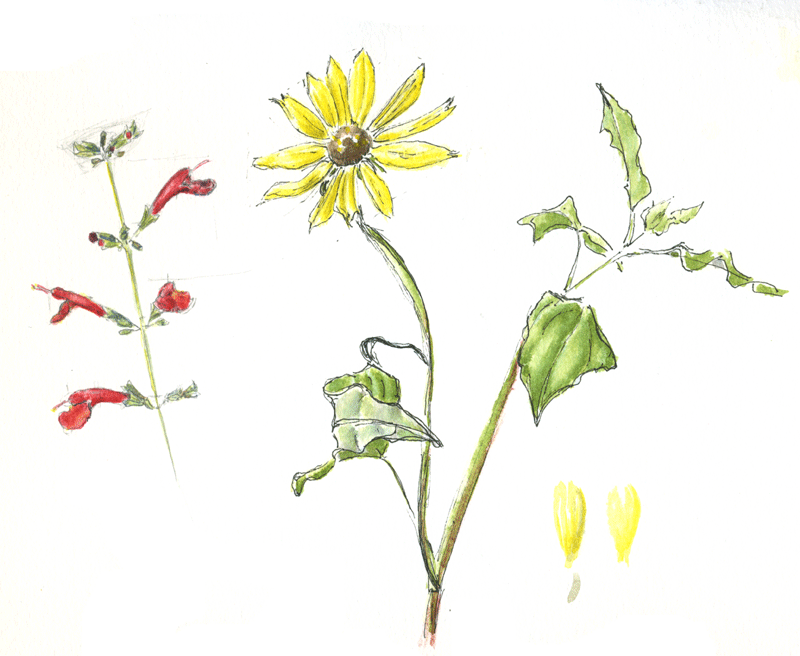
Dune Sunflower, Helianthus debilis, a semi-vining, scrambling beach native.  It takes  major drought to slow it down.


It's hot. Hot and humid, with heat indices in the 100's for most days. The whiteflies are going to town, and it's time to dispose of  expiring tomato and pepper plants. Native plants are far from immune, one reason I pulled out bushels of spent Gaillardias about a month ago. In Florida Weather, Morton D. Winsberg writes, "... air over Florida in summer becomes so humid that conditions are similar to those during rainy season in the Amazon or Congo basins." (p.94). By afternoon in summer our skies typically are hazy, even milky due to the humidity.


The weather may have been keeping me indoors for much of the day, but life in the garden continues at a frantic pace. The Lignum vitae, Guajacum sanctum, completed a glorious flush of blooms the last week of June. The blooming period is short - only about a week - but the intensely blue-to-violet flower petals are so gorgeous that I can't mourn the briefness of their stay. Besides, there will be more flushes as the year progresses.


Lignum vitae, Guajacum sanctum


This very slow-growing tree has shiny evergreen compound leaves and deeply textured grayish bark. It will grow tall and spindly in deep shade, but given more sun, it often develops a somewhat spreading habit. The trunk of the one in our yard is virtually prostrate. It had to grow out instead of up to get the light it craved, and two hurricanes enhanced the lean.  The plant definitely adds to the garden even out of bloom. Birds love to perch in it. The ornamental seed pods remind me of small golden turbans. They open to expose shiny black seeds covered with a fire-engine red flesh which mockingbirds and cardinals relish.


Open Seed Pods and Shiny Red Flesh Covering the Seeds


Since this tree has such a slow growth rate, it's not surprising that the wood is extremely tough. It is so heavy it won't float. The high resin content - about 30% - means that items made from the wood are self-lubricating, and it has been used for centuries, especially in shipping, for bearings and pulleys, and in food-handling machinery to avoid contamination. Gil Nelson writes, "Hinges made from lignum vitae served the locks of the Erie Canal for over 100 years." (The Shrubs and Woody Vines of Florida, p. 371).

 The resin gives it great tensile strength as well. Belaying pins, cricket balls, croquet mallets, British police truncheons, and mortars and pestles are some of the many other items made from this wood. Lignum vitae wood was used for the "aft main strut-bearings for the USS Nautilus," the first nuclear sub in the world. An item of trivia : images of the flowers, which are the state flowers of both Jamaica and the Bahamas, were embroidered in Meghan Markle's wedding veil. (Most of this information is from the Wikipedia article on Lignum vitae).


The discovery of the wood's qualities coupled with the fact that its sap could be used to treat symtoms of syphilis, meant that from the 1500's on, vast quantities were cut and shipped to Europe. This native of tropical America, from roughly northern South America to the Florida Keys, is now endangered. Fortunately it can be grown from seed, and grows well in cultivation. If you ever get the chance to visit Lignum Vitae Key State Botanical Park, don't miss it! Lignum vitae key has one of the very few, perhaps the only, virgin tropical hardwood hammock left in Florida.

Now, back to the Sahara. In spring, summer and early fall, vast clouds of dust from the Sahara desert collect in masses 1-2 miles deep, and 5,000 - 20,000 miles high in the atmosphere. These clouds of dust can be as large as the continental US. The Saharan Air Layer, as it is called consists of hot, very dry dusty air containing much mineral dust, and can be associated with strong winds. It tends to weaken or depress tropical storms, especially tropical cyclones moving across the Atlantic. (article by Jason Dunion. I can't get a direct link to the article to work, but you can find it on the NOAA website. In the search box type "Saharan Air Layer," and it should take you to the article). Because it blocks the sun's rays, it also diminishes local convective thunderstorms, which along with seabreeze collisions are a major source of Florida's summer rain. While the SAL is in place, we can pretty much forget about rain. I don't think the SAL extends much farther north than South Florida in the U.S., but I haven't been able to confirm that yet.

For a fascinating overview of the contents of Saharan dust, and the effects it has on the earth, including fertilizing the Amazon and sequestering carbon in the ocean, read Jason Adetunji's article, "What Dust from the Sahara Does to You and the Planet." (I can't get a link to work for this article either, but it appeared appeared in theconversation.com. You can find the article by entering the title in the search box).


The reddish soil in an agricultural area in Miami-Dade County known as the "Redlands" is possibly the result of tons of deposited Saharan dust, which contains iron particles.


Scarlet Sage and Dune Sunflower


Thursday, June 21, 2018

7-Year Apple

7-Year Apple, Genipa clusiifolia, is a wonderful native plant that should be used more in south Florida. It doesn't make sense that it can be hard to find, because it should be a gardener's and landscaper's dream plant. Though it bears individual flowers intermittently all year, the "big event" occurs in  spring and summer. Then it produces intensely fragrant white, star-shaped flowers over the entire shrub. Flower buds and the tips of petals are apricot-colored. Even out of flower, its large (up to 6 inches long), evergreen glossy leaves make it a good choice for a medium-to-large sized shrub/small tree. The smooth leathery leaves are slightly turned under along the margins, which lowers the transpiration rate.


7-Year Apple - Staminate Plant


 A lot of plants are said to be trouble-free, but this one really is. Nothing bothers it. It grows freely on the back side of the beach dunes here. It is extremely drought-and-salt tolerant, untroubled by diseases, and free of insect pests. It is listed as the larval host of the Tantalus Sphinx Moth, but ours has never shown any evidence of chewing. In general it is also wind-resistant. Ours came through Hurricane Wilma in 2005 with minimal damage. Irma, last September, though, tore it apart.

When we moved to our house on a barren lot I broke a cardinal rule of gardening - don't place shrubs and trees too close to each other. I knew the theoretical mature size and spread of the things I was planting, but could not visualize how the bare slips I was committing to the earth would ever reach those dimensions. Besides, I didn't expect everything to thrive. I planted a Jamaica Caper, the Genipa, and a Coontie (Zamia pumila) on 3-4-foot radii in the vicinity of a medium Christmas Palm. Then later, I added a Lignum Vitae (Guajacum sanctum) which had outgrown its pot because there seemed no other place to put it.


 For a few years everything in the garden was lovely, and then everything took off at once. The Coontie has formed a massive clump at least 5 feet in diameter, and the Jamaica Caper is 12-15 feet tall. The Lignum Vitae, which already had developed a spreading form in the pot, spread even more in competition with the others. The Genipa started getting shaded out. Genipa bears most of its leaves in clusters at the ends of its  branches, so it is sort of hollow "inside," but the growth is typically dense and compact enough to protect it from wind. The branches on ours had become so elongated and spread out that Irma's winds ripped the shrub apart. It is badly disfigured now, and the problem of too little space for too many plants remains. But it is blooming so profusely now that I can't bring myself to be rational and ruthless.

My main reason for loving it is its incredibly fragrant flowers. By now  the Jamaica Caper has ceased flowering, but the Genipa is still going strong, and I go out at least once a day, but usually more, just to get my "hit" from the fragrance. Butterflies, skippers, other small insects, and probably moths, love the flowers too. Ours started blooming in March and is still not slowing down.


Gulf Fritillary and Genipa


The plants are dioecious - that is each individual plant has either "male" (staminate) or "female"(carpellate) flowers. The staminate plants produce clusters of flowers, while carpellate flowers appear singly. When you buy a Genipa, it's the luck of the draw which one you get, same as with hollies. You'll get fruit only with a carpellate plant close enough to a staminate plant to be pollinated.


Immature Fruits


The immature fruit isn't quite so "deco neon" - I'm no master of Photoshop Elements! In spite of the name, the fruit takes about a year to mature. Fruit in various states of maturity can be found on the same bush. It starts green, turns yellow, and then dark brown when ripe. It is about the size of a Comice pear. It is vaguely edible, but not palatable.


Fallen Ripe Fruit


I've never eaten a fermented prune, but that's what came to mind when I tasted Genipa. The fruit is little more than a pulpy sac containing numerous seeds, which are said to be emetic. Mockingbirds apparently have developed a trick of pecking a small hole in the fruit and eating the inside goodies - leaving an empty sac still hanging on the branch. Other wildlife, especially raccoons, eat the fruit as well.


Smashed on a Concrete Walkway
Anybody Hungry?


7-Year Apple is native to Cuba, the Bahamas, Turks , Caicos, Bermuda, and southern Florida. It grows in sandy or rocky substrates. Why do garden centers concentrate on exotics that need coddling when there are natives like this?


Tuesday, June 5, 2018

Summer Fragrance

One of the things that defines the transition from spring into summer here in the garden is fragrance. It starts with the Gardenia, whose heavy tropical fragrance  envelopes you like humidity, feels liquid enough to drink. Gardenias seem to suggest a seductive beauty, sultry southern nights, the songs of Billie Holiday. Sticking your nose into a gardenia flower and inhaling is near-intoxicating, as "high" as I need to be.


Since gardenias love acid soil, keeping one remotely happy in our alkaline conditions is a constant struggle, and Irma's salty winds set it back even more, but it still bloomed.  Right now it is teetering between permanent decline and slow recovery. Perhaps I should just replace it. The front yard, more protected from salty winds and a little shadier, might be a better location, but the front is crowded already. I would have to redo the area by the front door or dining room window (same area) so that we would be able to enjoy the perfume. Just one of the many landscaping dilemmas one runs into in a  garden, especially one as small as ours.


If the gardenia is like a heavy wine, the frangipani, Plumeria sp., is more like a refreshing sip of lemonade. Plumerias practice deceit pollination. Their light, sweet odor promises nectar, but the flowers don't deliver. Insects, especially the sphinx moth, keep looking for the nectar in vain, thereby transferring pollen.  Traditional Hawaiian leis are made of frangipani blossoms.


Yellow and White Blossoms Are More Frangrant Than Reds and Pinks


Frangipani copes with winter drought and cold by losing all its leaves, and the turgid, lumpy, leaf-scarred stems look dead. The first new growth and the flowers sprout from the very tip of the stems, and have an oddly other-worldly effect when in bud, like some growth out of science fiction.


New Leaves and Flower Buds


Frangipanis typically grow wider than tall. Thanks to Irma, our frangipani is leaning pretty badly. I may try to stake it, or just leave it as is, pretending I'm striving for a more picturesque effect. Before I do anything, I have to remove a mass of Gaillardias, but they're still blooming vigorously.


The flowers of Jamaica caper (Capparis cynophallophora) and 7-year apple ( Genipa clusiifolia) begin opening about the time the gardenia peaks. Just breathing near these 2 shrubs on a warm, late afternoon is a sensuous - even sensual - experience. This is when the white flowers begin serioiusly releasing their fragrance, sending olfactory signals to lure the moths that will pollinate them overnight. They are visited by day-flying insects and butterflies as well, and emit periodic bursts of fragrance throughout the day.


"Morning After" Pink Flowers


When in bloom Jamaica caper is one of our most beautiful native plants. White 4-petaled flowers open in late afternoon or early evening and in the course of the next couple of days morph through a suffused pink to deep maroon before falling. Numerous long stamens whose filaments go through the same color progression as the petals radiate out from the flower's throat, creating a startling beauty.  During the day the flowers can be humming with bees and small flies. I have noticed monarchs nectaring on them as well.


Jamaica Caper in Bloom


The plant's glossy evergreen leaves, which reflect light strongly, make the plant attractive even when it is not in bloom.  Rufino Osorio writes, "The leaves are an extremely dark green .... The effect is hard to describe - the plant appears both dark and bright at the same time." (A Gardener's Guide to Florida's Native Plants, p. 239). Numerous scales give the undersides of the leaves a scurfy appearance. New twigs are cinnammon brown, and older wood is gray.


Jamaica Caper Inflorescence


The seed pod is a brown pod 4 - 8 inches long. The pods on my shrub are more like 3 - 4 inches long. Linnaeus thought they resembled a dog's phallus, hence the species name, cynophallophora. Folks in those days apparantly were less prudish than we are, despite  our foul language, and called things as they saw them. The inside of the seed pod is bright red, and the open pods extend the decorative  phase of the shrub. Cardinals and mockingbirds relish the seeds.


Open Seed Pods


Jamaica caper is an absolutely "cast iron" landscape plant in frost-free areas of Florida once it is established. An inhabitant of coastal hammocks, it is both drought and salt-tolerant. It is untroubled by disease or pests. Occasionally ours shows some light damage from the leaf-rolling larva of some insect. Only  once in the past 20+ years has it become noticeably defoliated, and it recovered quickly and completely. I never water it, though since it is close to the seawall, its roots no doubt reach into the brackish water table. During a close pass of a hurricane years ago, salt/brackish water 1-3" deep covered the root area for several hours during high tide without doing any damage.


Our Jamaica caper was not damaged much by Hurricane Irma. Again, the root area was under water until the storm surge subsided. In fact, much of the back yard was covered during the surge, but no plants suffered any noticeable dmage from the inundation. (The surge line didn't reach the gardenia). I can't remember if or how badly the Jamaica caper was defoliated. There was just too much other stuff going on. There were very few broken branches. In any event, now you'd never guess it had been through a hurricane, while the eastern side of the bougainvilleas in the front yard is still not completely leafed out.


I haven't made a  satisfying watercolor of the Jamaica caper flowers in all the years we've lived here. My quick studies don't capture the glossiness of the leaves or the combination of grace and sturdiness that characterize this lovely plant. But I try.


Jamaica Caper


Next up : 7-year apple.