Showing posts with label Heliotropium polyphyllum. Show all posts

Tuesday, October 30, 2018

Leaf Cutter Bees

A week or so back I was delighted to see the chewed margins of this pipevine (Aristolochia sp) leaf. Chewing is usually cause for alarm in the garden, but in this case it is evidence of leaf cutter bee activity, something to be welcomed.


A Leaf Cutter Bee Was Here!


The species I see could well be native to Florida. It also could be Megachile rotunda, the "alfalfa bee," imported into the U. S. after the 1930's to: you guessed it! pollinate alfalfa fields. Honeybees are not efficient pollinators of alfalfa. This useful little critter has spread since then to much of the U.S.

The family of leaf cutter bees, Megachilidae, contains at least 2,000 species, and occurs virtually worldwide. Around 63 -75 species can be found in Florida alone. Another common leaf cutter bee, the "mason bee," Osmia sp., constructs its egg chambers with leaves and mud. Osmia bees are produced commercially and can be ordered over the Internet.

The Megachile bee is about the size of a honeybee. It does not sting unless provoked, and the sting is said to be less painful than that of a honeybee. It is somewhat chunky, with black and white bands on the abdomen and black on the upper thorax. Both sexes are generalist pollinators - they like just about everything. Only the female nests. Instead of packing pollen into leg pouches like honeybees, she carries it on the underside of her abdomen.


Megachile on Heliotropium polyphyllum 


She will nest in just about anything the right size and shape - oarlocks, unused hoses, rotten wood, hollow twigs, burrows, or manmade nesting boxes. In Florida the bees also like holes drilled in stucco for fastening hurricane shutters! Nests in underground burrows don't seem to be affected by short-term inundation, or by getting gradually filled in.

Once she has found a suitable nesting place, the female cuts a round bottom plug, and then builds up the chamber with overlapping oval pieces of leaf. She cuts  these sections out of leaf margins one at the time. She works smoothly and precisely, taking only a few seconds. She's so fast that you're lucky to catch her in action. She carries the leaf section slightly curved, under her abdomen, to her nest. I've timed a bee in action, from entrance to exit from burrow.  She takes 60 to 90 seconds to get the new leaf section in place.


Megachile Carrying Oval Leaf Section


When the chamber is complete she packs it with a mixture of nectar and chewed pollen, lays a single egg, and departs to cut the circular seal, or plug. This is when the closely related cuckoo bee. Coelioxys sp., may make her move. She crawls into the nest, and lays her egg, which will hatch and eat both pollen and competing larva.

The  Megachile bee makes a series of chambers, one atop the other. The resulting cylinder is said to resemble a cigar somewhat. It would have to be a cigar no bigger in diameter than a straw. I extracted one from an oarlock one year and kept it in a dish. After a month or so, a faint, persistent buzzing told me that something was happening, and sure enough, one bee, followed quickly by another, emerged. At this point I took the bees and the rest of the cylinder outside where they belonged.

Leaf cutter bees live only a few months. The female dies after she completes her egg-laying. The larva pupates and overwinters in the nest as an adult until it emerges in the spring.
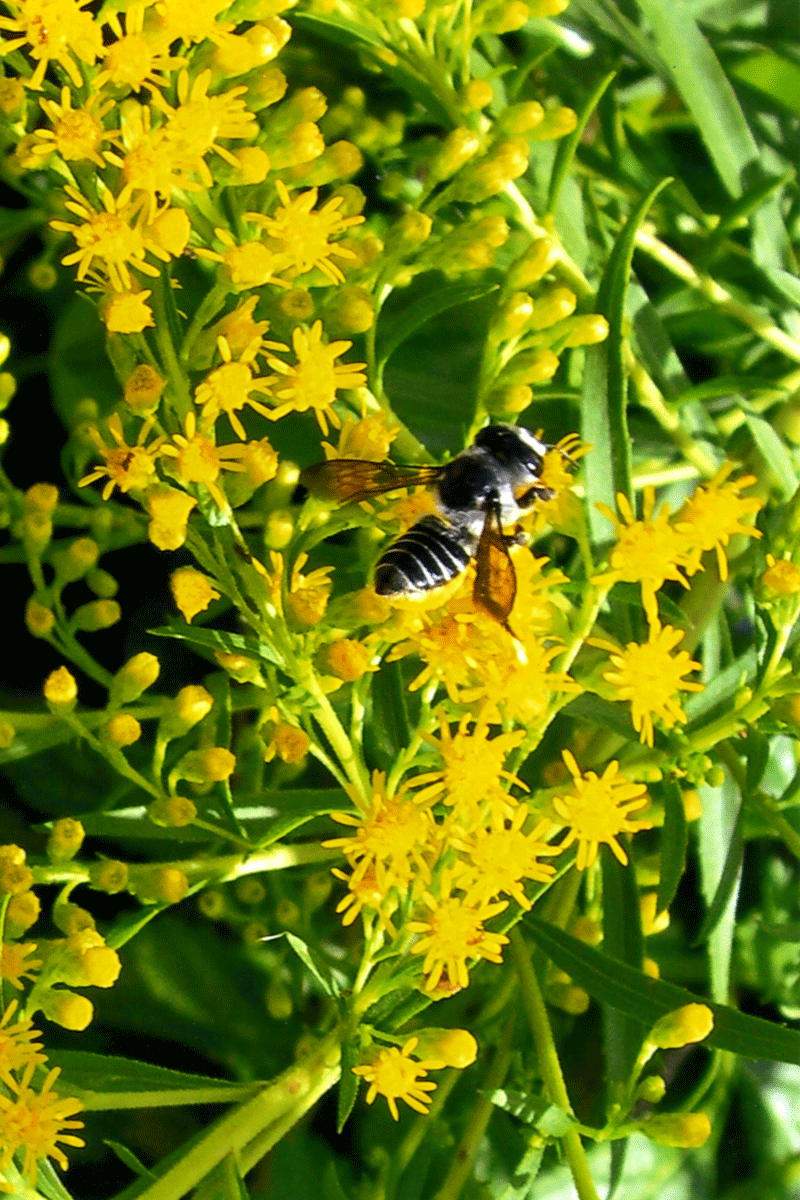


Megachile on Goldenrod


If you're trying to grow a prize rose or dahlia for exhibition, the leaf cutter bee could be a nuisance. Otherwise, since they are solitary, not part of a colony, the damage they do is minimal, and I think just adds interest.

There is a wealth of information on the Internet about leaf cutter bees. The Honeybee Conservancy site has great info, pictures and video. Click the following link to get to the site. leaf cutter bee. The University of Florida also has a good article. Go to edis.ifas.ufl.edu/in619. Another of my favorite sites is from the BeeInformed organization. https://beeinformed.org/2014/07/30/alfalfa-leafcutter-bee-.


Megachile Work on Gopher Apple, Licania michauxii


Honeybees  have the reputation of being the best crop pollinators, but that is not necessarily the case. Our native bees are vital in the pollination of crops, ornamentals and our native flora. I don't know whether the one in my yard is a native or the imported alfalfa bee, but either way it is more than welcome.


Tuesday, December 12, 2017

Damn the Torpedograss!


       The native white-or-yellow-flowered Heliotropium polyphyllum and the lavender exotic Heliotropium amplexicaule make good groundcovers where foot traffic is light. They are popular with butterflies and other pollinators. They tend to die back in the dry season for me because I don't give them much water, and in really dry and windy stretches they may get attacked by whitefly. I cut them back hard a couple times a year to keep them looking good. Heliotropes are members of the borage family, and their old leaves turn black. If you don't cut them back periodically you end up with a thatch of dead leaves and bare stems with just some ratty foliage on top. They don't seem to compete well in my yard, so it takes occasional, but regular, weeding to maintain a nice patch.


Heliotropium polyphyllum
"Pineland Heliotrope"

This species also does well in coastal, sandy areas. I rescued mine from a vacant lot that was about to be developed.
     
       Some years ago I noticed some grass appearing in a patch of Heliotropiums in the back yard. Ignoring it turned out to be a huge mistake, because it soon was choking out everything in that small quadrant. 
            This was my introduction to  Panicum repens, aka “torpedograss,” “quack grass,” and “bullet grass.” Truly a weed from hell, this grass is a serious problem worldwide. It is native to parts of Asia and Africa. Though it grows from seeds, its main method of attack in Florida is by way of tough rhizomes (creeping underground horizontal stems), which can extend downward more than 2 feet. The rhizomes produce sharp stiff points – the “bullets” or “torpedoes” – that penetrate weed barriers and even thin paving. Any little piece of the rhizome can start a new plant. "My" torpedograss probably sneaked in from my neighbor, who didn't have a lawn, but just kept his weeds mowed to give an illusion of green. Turf grass doesn't do well in South Florida, so I'm not blaming him! He no doubt was "infected" by somebody else.

Panicum repens rhizome and parts of blades

            Torpedograss was around in the late 1800's, but became widespread with the help of the USDA, which reportedly imported and distributed seeds for planting in pastures in the 1920's. It's not    clear whether torpedograss even provides good forage.
            Now this serious pest of cropland, citrus groves and natural areas extends throughout Florida and along the Gulf Coast westward through Texas. It also occurs in Georgia, South and North Carolina, California and Hawaii. It tolerates just about any soil, growing both in dry sand and in the rich muck of swamps and lakes. It grows rampantly in warm weather, and slows down in the cooler months. The blades can grow 3 feet tall or more.
            The largest infestation in Florida is around Lake Okeechobee, where it has displaced at least 7,000 acres of native marsh. IFAS (University of Florida Institute of Food and Agricultural Sciences) estimates that it has invaded 70% of Florida's waters. It is especially insidious because it closely resembles, and grows alongside, the native  maidencane (Panicum hemitomon), a vital part of the natural ecosystem, making efforts to control it even more difficult. 
            The State of Florida spends millions of dollars a year on management of this pest. In the words of Dan Gill, garden columnist for the New Orleans Times-Picayune, "Torpedograss is not difficult to eradicate: It is nearly impossible to eradicate.”
            Glyphosate is the herbicide most recommended for chemical control. Repeated sprays at the highest label rates are required. There are problems with Glyphosate, though. It is  non-selective herbicide, meaning it kills anything, so any spray drift or drips can be lethal to plants you don't want to kill. 
             I literally painted individual stems and leaves of the grass with a pastry brush saturated with high-rate Glyphosate mix. (I wore gloves and protective clothing). Even though the area was small, this was time-consuming, back-and-knee-killing work. It had to be repeated, and it didn't eliminate the problem.  Even though I was careful, there was collateral damage, especially to a Florida native called gopher apple (Licania michauxii).  It's pure speculation on my part, but I wonder if there was some root-to-root, or soil-to-root transfer of the herbicide.

Licania michauxii
"Gopher Apple"


            After the initial kill I dug out as many rhizomes as I could. The stems are strong, and when pulled, may just break off at ground level. Any parts left underground merrily continue growing. I had to get down and dirty to get at the rhizomes – a delicate operation since they were intertwined with the roots of desirable plants, so no matter how careful I was, I still damaged the plants I was trying to save.  I was amazed at both how deep and how long the rhizomes extended. Every time I pulled out one a foot long or more, I felt like I'd bagged a "big one!"
            That was about 7 years ago. I no longer use Glyphosate, but just try to dig, clip, and pull. Given the amount of work it has taken to keep it under control in an area no bigger than  20’ x 20’at most,  the scope of the problem in Florida and the rest of the world is staggering. It would be nice if our nursery and agricultural agencies would learn to “just say no,” to imports sometimes.

Megachile (Alfalfa Bee) on Pineland Heliotrope


For more information on Torpedograss:


 Gill, Dan. “Go on the Offensive Against Torpedograss.” New Orleans Times-Picayune. July 19, 2012.


“Panicum repens L”. Langeland, Cherry et al. University of Fl.-IFAS Pub. Sp257. 2008. Center for Aquatic and Invasive Plants. University of Florida, IFAS. Also available through Florida Exotic Pest Plant Council.  www. Fleppc.org.


USDA Plants Database. Plants.usda.gov.


Yarlett, Lewis. L. Common Grasses of Florida and the Southeast. Florida Native Plant Society. 1996. P. 143.