Looking out the dining-room window, my frequent perch, I see an abundance of color in the front yard. The bougainvillea has burst into another flush of bright magenta bracts, with their tiny, enclosed white flowers. Scarlet sage, Salvia coccinea, is blazing with impossibly red flowers.
I tried to establish this plant unsuccessfully for years. A while back, though, one of my sisters gave me a pot of something else with a Salvia straggler, and it has spread itself throughout the back yard as well as in front. When it gets leggy and unsightly, which it does, I either cut it back to the last green leaf, or just break off the now-brittle stems.

Scarlet Sage, Salvia coccinea
Blue-gray Eliott's love grass has peaked.Now it's drying, and its multiple seed-laden inflorescences are brittle enough to break off in the wind. They also like to work their way up your pant leg. Pink muhly blooms later, and is also now past its prime. Its multitudinous inflorescences are somewhere between pink, purple and magenta. A clump of muhley grass by itself is a grand specimen, and it is really stunning in a mass planting, especially when there is just hint of breeze. Mounds of it billow and blow in a highway median a few miles away.
Goldenrod, Solidago sp., has been blooming since June. Mine was a pass-along plant from a now-deceased friend in the local native plant society, who warned me, "once you have goldenrod, you'll always have goldenrod." Every time I root out another clump of suckers - goldenrod has expansionist tendencies - I remember Freda and her down-to-earth wit. Right now it is growing intermixed with a large, spreading mauve lantana, and the color combination works. I didn't plan it that way, but the goldenrod moved in on the lantana, and the 2 seem to coexist reasonably well, perhaps because the lantana stays low and the goldenrod reaches for the heights.
Florida has 19 species of goldenrod, and apart from the few that don't occur down here, I'll be damned if I can identify mine. I'm probably overthinking the process, but every time I think I am keying it out successfully I find a characteristic that nullifies it. Besides, I think they hybridize fairly promiscuously.
 |
| "My" Goldenrod from Freda |
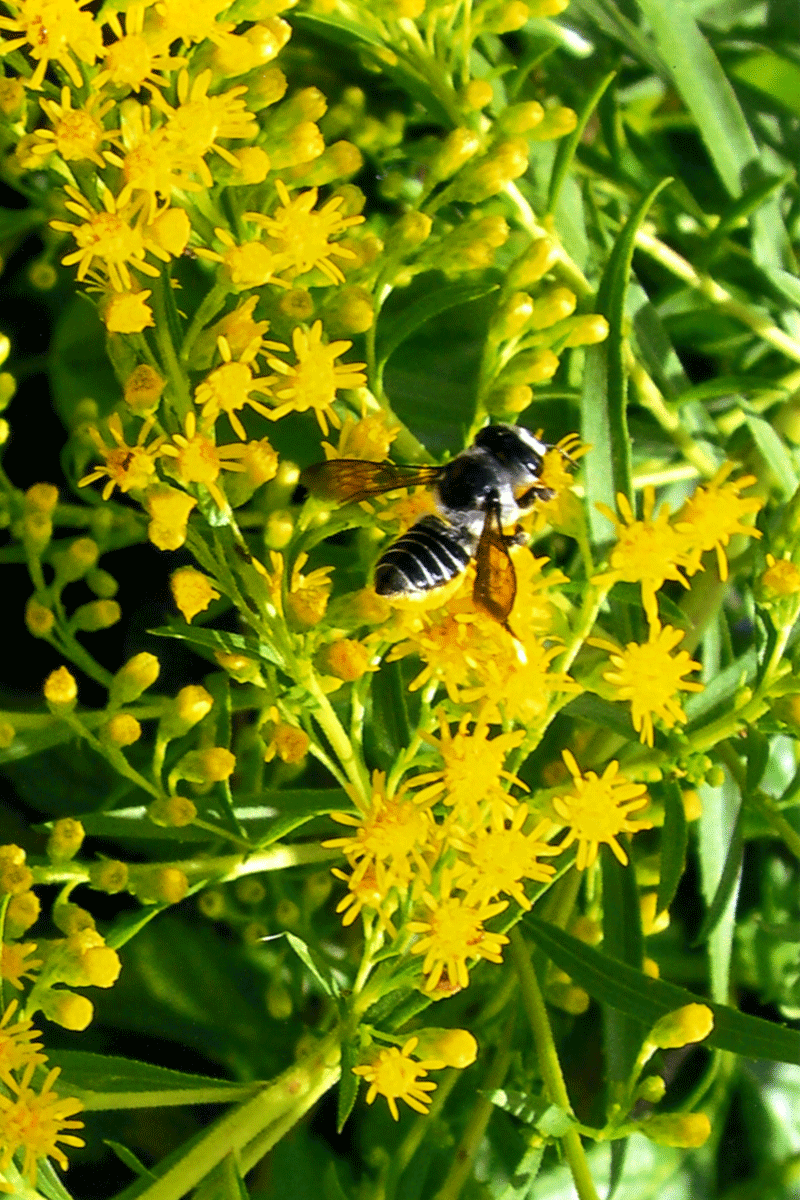
Even though it blooms all summer here, goldenrod still seems to symbolize fall like pumpkins, asters, and fresh apples. Its numerous bright, saturated yellow-gold heads are intensely attractive to insects. Butterflies do use it in our yard, but they are far outnumbered by the wasps and bees that find it irresistible.

In the photo above, a leaf cutter bee, Megachile sp., gathers pollen. The photo doesn't show it, but these medium-size bees collect pollen on their abdomen. I don't think the megachile in our yard is native, but I can't see that it does any harm. This species builds cylindrical egg champers in underground tunnels. It also will use holes for oarlocks and unused garden hoses. It cuts uniform oval shapes for the sides, and perfect circles to close off the egg chambers. Each compartment is about an inch long and a quarter-inch in diameter. The bee will make several chambers in each nest. It doesn't matter if the entry hole gets covered, either by shifting sand or waterborne debris. I extracted a cylinder once and kept it in a plastic dish at my workspace. All the cylinders produced an adult bee within minutes of one another. I liberated the bees after they hatched.

Paper wasps, Polistes sp., also love the flowers. In my experience, most bees and wasps aren't particular aggressive when they are feeding. Once, though, a big bumblebee traveled from at least 6 feet away just to sting me, so I don't know what its problem was. This wasp is in no peril, but its perch reminds me of times I've had one foot on the dock and the other one on a boat that was inexorably moving away. (There is no end of entertainment watching boats come and go at a boat ramp or dock. As long as nothing tragic happens, you can laugh, but you have to remember that sooner or later it will be your turn to look stupid).
Goldenrod flowers and leaves have been used medicinally for centuries. In fact, the genus name, Solidago, means something like "to heal or make whole." It also is a traditional dye plant. I can't speak for all species, but this one is extremely forgiving of sandy pseudo-soil and drought. Its tall spikes could be staked, but I sort of like to let it sprawl and flop. It gets beaten flat by a hard rain, but usually more or less recovers.
Alas! All my wonderful color is in danger of being obscured by rampant weeds and overgrowth of natives I have allowed to self-sow. Now that the weather isn't quite as hot, I need to get busy before Code Enforcement shows up. Cleaning up the yard will be a great antidote to stress from COVID and politics. The Presidential race seems decided, but the country remains as bitterly divided as ever. We all need to chill out a little and go plant something.

This post is woefully late. Sometimes life just happens. Eta scared us, but gave us a miss, though we had winds strong enough to flatten the goldenrod, coreopsis, and Elliott's asters. Most are now trying to straighten out, but I probably will have to cut the coreopsis back because its stems are so incredibly thin it's hard to imagine that they hold up a whole flower head even in the best of circumstances.
I haven't figured out how to make links in the new Blogger format, but for more information you can refer to the posts listed below.
Native Grasses: "Yes, Florida Has Seasons." Nov.14, 2017.
Leaf Cutter Bees: "Leaf Cutter Bees." Oct. 30, 2018.
Elliott's Aster: "Elliott's Aster." Jan. 23, 2019.