Thursday, January 31, 2019

Tomatoes Redux

Last year I complained about my sorry tomatoes. ("Trouble with Tomatoes," 3/19/18). This year has been a completely different story. We've been having sweet, red tomatoes for over a month now. As a former Master Gardener getting it right should have been a no-brainer for me, but it's taken me only about 25 years to start geting the hang of vegetable gardening in sw Florida.

I suspect that the main difference was much earlier planting. I also used better potting soil and a bigger pot, and positioned it close enough to the hose that it was easy to water. I bought an "Early Girl" start, and fertilized it with slow-release pellets. At the moment the plant is looking rather sorry, and apart from its last ripening fruits, has just a few flowers. There may be something wrong with it, but more likely, it may have run its course.

 Even though it is resistant to both fusarium and verticillium wilt, "Early Girl" is not listed as particularly well-suited to south Florida by the University of Florida, IFAS. However, it was recommended to me by an experienced gardener here, and I was familiar with it from earlier gardening days in Georgia. So far there's been no damage from birds, but the Grackles show up in force in late winter and spring. I suspect them as the main culprits. Insect activity also picks up with warm, windy and dry spring weather.


"Early Girl" Watercolor and Colored Pencil


Last week I planted 2 more tomato slips, and they already have produced small green tomatoes. It will be interesting to see if they have time to ripen before the weather gets too hot. Ditto for the lettuce and sweet alyssum seeds I planted along the rim of the pots.

I'm doing an online course in colored pencil with Wendy Hollander, organized by Karen Abend. It's just a little task each day, and so far I've been more or less able to keep up, despite a frustrating elbow injury. Along with the colored pencil technique itself, it's also a review of basic drawing skills, which certainly is not wasted on me. I'm very pleased with what I'm learning, if not by what I'm doing. I've got a long way to go with colored pencil, as my tomatoes below show. I was trying different colors for shading, and got much too heavy-handed with the dark sepia in the tomato on the left. In fact, two of the tomatoes look more like apples to me.


"Early Girl" - Colored Pencil


I still need to contact Harry's Tasty Tomatoes (see my 3/19/18 post  ). No matter what seeds I may get from him, I think I will keep "Early Girl" on my list of Florida favorites.

I also have beautiful kale under the Fiddlewood. (I need to do a post on that wonderful plant. It provides just the sort of dappled shade under which so many plants thrive, and is a favorite perch for the few songbirds we get here). I'm picking it young, so I can braise it with plenty of garlic and some broth, and then add it to sauces or stir fries. To my way of thinking, a lot of recipes underestimate the time it takes to cook "greens." That includes baby kale. I just keep checking until I think it is tender, regardless of the cooking time given. I don't mind a bit of crunch in most vegetables, but undercooked greens to me are about as chewable as grass clippings, which doesn't mean they have to be cooked "dead," either. The bigger and older the leaves, the longer they need to cook.


Kale Mix from Burpee


The wonderfully textured and/or crinkled leaves are endlessly fun to draw, as long as I don't grimly attempt to get every little curlicue right. This sketch started out as ink (Pigma Micron #005) and watercolor. I made the mistake of using yellow for the highlights, but that made the leaves look sickly, so I tried to brighten them up with watercolor pencil, which didn't work too well, and colored pencil, which worked better. Some of the varieties are very blue-green, which I didn't capture here.


Wednesday, January 23, 2019

Elliott's Aster

Elliott's Aster, Aster elliottii, (or now Symphyotrichum elliottii) is still blooming, though not as robustly as a month ago. For me it usually flowers in late fall through early winter, but if spring were not so dry here it probably would keep going for one more season. It is one of my favorite native plants, even if I constantly have to contend with its expansionist tendencies.


I was playing around with the concept of "negative painting" in this loose sketch.


 Though it seeds profusely, in moist or wet soil it spreads enthusiastically by rhizomes to form dense colonies. An individual plant starts out from a basal rosette, which by and large disappears as the plant matures. Plants reach 2and one half to 5 feet tall. Mine never get more than 3 feet tall, probably because they don't get any extra water. (They grow in a section of the yard that stays relatively damp most of the year). Spring is windy and hot here, and my asters go fairly dormant until the rains return in summer, when I have to start pulling them out to contain their spread.


Bottom Part of Plant - Basal Rosette Has Disappeared


 Heads are produced at the ends of stalks and branches. They consist of both ray and disk flowers. The ray flowers are a purplish-lavender. The ray flowers in our plants are quite pale, but can be considerably darker in others.

 Leaves are alternate and lance-shaped, with the widest part near the tip (oblanceolate). They become progressively smaller as you move up the stem. The leaf margins have teeth.


I allow Elliott's aster a little corner of the front yard. Perhaps I should let it take over, but I don't find it that attractive out of bloom - just a thicket of green. However, a colony of Elliott's aster in bloom puts on a real show.


Colony of Elliott's Aster in Bloom- Photo by Jeanette Lee Atkinson


The plant  is named for Stephen Elliott (1771-1830), a fascinating and remarkably accomplished individual. He was born and died in South Carolina, and was educated at Yale. He enjoyed a productive career in the South Carolina legislature, where he was instrumental in passing laws establishing a public school system and a state bank. He was a major influence in the creation of the Medical College of South Carolina, where he lecturerd on natural history and botany.

Like many educated people of his day, he was an avid natural scientist, and corresponded with leading colleagues in both the U.S. and Europe. His  A Study of the Botany of South-Carolina and Georgia, which appeared  between 1816 and 1824, is considered one of the most important botanical works in the United States. (This biographical information is taken from an article by George Rogers in the South Carolina Encyclopedia, www.scencyclopedia.org/sce/entries/elliott-stephen).

Elliott was so respected that the genus Elliottia was named after him. In Florida alone no fewer than 12 plants have his name as their species epithet. One of the most beautiful, Elliott's love grass, Eragrostis elliottii is shown below.


Elliott's Lovegrass - Jeanette Lee Atkinson


Elliott's aster occurs in moist conditions throughout the southeast and west through Louisiana. It is very popular with pollinators, and it never has suffered from insects or diseases in our yard. It lasts a reasonable time as a cut flower.


Elliott's Aster, Top Part of Plant, Graphite Pencil

Tuesday, January 1, 2019

Rivina

It's been too windy for the past weeks for comfortable outdoor sketching, but  at least I managed some quickies of rouge plant, Rivina humilis, a delicate understory shrub. I always think of bright green and red as Christmas colors, and this year Rivina delivered. As of Jan. 1, 2019, it is still flowering.


Rivina humilis - in Aquabee 93 lb sketchbook


As the species epithet "humilis" indicates, rouge plant is low-growing. Some of my sources have it reaching 5 feet, but I've never seen one taller than 3 feet. The stem is woody, while the branches can be spreading and almost vine-like. Especially in deep shade, the branches droop over and around surrounding vegetation - as though they were too delicate to support themselves.

My plant is a semi-volunteer, growing in the dappled sun/shade under a medium-sized Simpson's Stopper. It is the offspring of a plant that languished and ultimately died in a nearby pot. It's present spot is pretty good for it in terms of sun and shade, but it is exposed to north winds, which it doesn't like. A week or so back we had 2-3 days of unusually strong sustained winds accompanied by even stronger gusts. The wind in combination with chilly temperatures bleached the edges of many leaves.

Rivina used to be included in the Pokeweed family, Phytolaccaceae, but is now classified in its own family, Petiveriaceae.

It is a very ornamental plant. The leaves are alternate. (New branches arise in the angle between an existing leaf and branch. This new growth can be so compressed, with branching upon branching, that it is next to impossible to tell what is going on with leaf arrangement. At least it is for me).  The leaf has slightly undulating margins and a smooth surface. The leaves are fairly squared off at the base, and pointed at the tips. The petioles can be quite long, and are gently hairy.

The flowers appear along a terminal spike, or raceme. They are only about 5mm in diameter, and lack petals. What looks like petals at first glance is actually 4 sepals, either pink or white. The fruit is a bright red, which has been used for dyes. The berry contains 1 black seed. Flowers and berries  can appear along the same stalkat the same time.


Despite its delicate appearance, Rivina is reasonably tough, growing in hammocks on the backside of the sand dunes, hammocks farther inland, and in disturbed sites. Most Florida natives are equipped to endure long periods of winter drought, but this plant likes a little moisture to look its best. It will flower and fruit in full shade, and doesn't thrive in unmitigated sun.

According to the USDA Plants Database, Rivina is native to Florida, Mississippi, Louisiana, Texas, Oklahoma, Arkansas, Missouri, New Mexico and Arizona. It also is native to the Caribbean, Central America, and tropical South America. It is widely naturalized in the Pacific islands, including Hawaii and the Galapagos, and has spread to Australia and Asia as well. In some areas it has become an invasive pest.

Rivina is an important food plant for birds, and the berries do not last long in our yard.

-----------------------
Blooming now: Dune Sunflower, Heliotropium, Blue Porterweed, Scarlet Sage, Pityopsis, Rivina, Blue-eyed Grass, Elliott's Aster, Tickseed, Bacopa, Bidens, Goldenrod, Gaillardia. Non-natives: Emilia, Scarlet Milkweed, Bougainvillaea, Dauben Waterlily, Tina Waterlily, Pentas, Marigolds, Blue Sage, Blue Daze.

Sunday, December 9, 2018

Silkgrass

A plant named "silkgrass" conjures up images of flashing silver, shining green, the play of light and shadow. Who would relegate such a plant to, "you still here?" status? Who else but yours truly, who never really took it seriously before looking at it close up recently. Although it may flower intermittently throughout the year, silkgrass, like many other members of the Aster family, blooms most heavily in fall. It has been showy for several weeks now (we're starting 2nd week of December) and shows no signs of slowing down.


Pityopsis graminifolia - Narrowleaf Silkgrass


Narrowleaf silkgrass, Pityopsis graminifolia, is one of 4 species found in Florida, and the only species of silkgrass occurring naturally in SW Florida. It is very variable in size and vigor. Currently botanists recognize 5 varieties, though they are not always easy to distinguish from each other. In scrub it tends to stay low to the ground, intermingled with grasses. In my garden, where it doesn't get any special care, but still has a much more favorable habitat than scrub or sandhills, it is more or less upright, with leaves 12 -16 inches long.


Habit Sketch


The plant grows as a clump, with long, grasslike leaves at the base. A tall blooming stalk grows from the center of the clump. The leaves on this stalk are also grasslike, and diminish in size as you move up. By the time you are within 4-5 inches of the heads, they are reduced to scale-like bracts.


Pityopsis graminifolia reproduces by rhizomes and seeds. It does not seem troubled by insect or disease pests, and it attracts various pollinators. The ray flowers are a clear, bright, pure yellow. The heads last several days, and the stalks can be cut for indoor flowers. The silver appearance comes from tiny hairs that cover virtually the entire plant. The bloom stalk and its leaves tends to be even hairier than the long leaves. The hairs no doubt contribute to the plant's incredible drought tolerance. In the right light an entire clump will shine brilliantly, blindingly silver.


Inflorescence and Middle Part of Stem


The plant would benefit from staking while it is blooming, and part of the reason for my lack of respect is that I've watched it falling all over itself and other plants for  years instead of doing anything about its untidy habit.

Now that I am in the process of simplifying the garden because I'm getting too old and creaky to take proper care of what I've got, I'm thinking very positively about transplanting some of my clumps to some particularly dry and exposed troublespots in the yard. If I can get it established there I can let it sprawl and spread as much as it wants. Given the right space it can shine literally and figuratively. I'm anxious to see what it can do.


Friday, November 23, 2018

North Carolina Interlude

 The first of November I spent a lovely week in the mountains of North Carolina with two of my sisters. The mountains were even more beautiful in fall than in summer and spring, my usual times to visit. The absence of summer haze meant a clear vista of slope after slope after slope, and the fall foliage was brilliant.


The famous plantsman David Fairchild titled his autobiography The World Was My Garden. Still, it would be a stretch to claim the mountains of western Carolina as an extension of my near-sea level back yard! I bought a new sketchbook just for this trip, so I'll review it here.

Over the past few years I've read a lot of rave reviews of the Stillman & Birn  sketchbook series, and I finally bought one. They come in various weights and finishes, and I dithered and dithered over which one to buy until I just took a deep breath and bought a Zeta, heavyweight (270 gsm), super-smooth, high-white paper.

For years my sketching standby has been Aquabee Super Deluxe Mixed Media paper (150 gsm), and the slickness of the Zeta took me by surprise. My pencils and pens seemed to slip  and slide all over the paper. Moreover, the  Zeta series paper doesn't immediately soak up moisture, and puddles of pigment tend to sit on the surface and take a good while to dry. However, this does make for some very interesting mixing on the paper effects, and wet in wet causes no breakdown of the surface, which can happen pretty quickly with other sketchbooks. There was some buckling of the paper where I got really sloppy, but that was mostly evident on the back side, and diminished some over time.

I did and still do have problems laying down an even wash on this paper without prewetting it. That could be me as well as the paper, though. So far, which isn't that far into the book, I still have problems hitting just the right amount of moisture. The sketch of the Japanese maple leaflet below shows my problems with washes.


Uneven Washes


Once I stopped fighting with the paper I really began to have fun. The top leaf in the next sketch is a sycamore, but I don't know what the other two are. The good old inner critic whom we all know and love, convinced me to give up on the bottom left leaf.  I couldn't get the beige-yellow of the beat-up old leaf correct, and I gave up in frustration. Once I got home I decided that regardless of the inaccuracy of the color, the sketch wasn't that bad, but I no longer had the leaf.


 I had more patience with my second attempt with a Japanese maple leaflet. I used multiple glazes of Winsor &Newton permanent rose, Daniel Smith quinacridone gold, and W%N quinacridone red, waiting for each layer to dry before adding another. The paper took all those layers, and likely would have taken more, without buckling or breaking down. I'm delighted with the clear, brilliant results I got.


Zeta is listed for mixed media, and back home I've tried it with both Prismacolor and Faber-Castell colored pencils. Despite the Zeta's lack of tooth, colored pencil goes on beautifully. Again, I had to modify my technique somewhat. I had to use hard pressure to make the pigment smear at all. Graphite, especially the softer grades, will smear if I'm not careful, but that is the nature of the medium.

The Zeta takes ink beautifully. The sketches above are done with  Pigma Micron, but I  have used a dip pen #104 at home with no scratching, skipping, bleeding or feathering. Even the juicy line of my medium nib Lamy Safari pen doesn't smear unless I deliberately and quickly get my hand or finger on it while it is still wet.

Now I know why other sketchers have raved about Stillman and Birn, though most seem to use the Alpha series. The main drawbacks of S&B over other sketchbook brands is that it is relatively pricey, and not as universally available.While it seems made for ink and watercolor wash, I don't know whether it would dry quickly enough for quick watercolor sketching on the go, especially for painters who like things wet. That might not be a problem in less humid areas.

The Zeta is very bright and very slick, even smoother, if possible, than Bristol plate. The most comparable watercolor papers to it that I know are Sennelier and Fluid hot press. It is ideal for the finely-detailed botanical illustration that I do back in the "studio," my dining room table. I am anxious to order some Zeta by the sheet, because even at this early point I like it better than Bristol and some watercolor papers.

My original plan was to start either with the Alpha or the Zeta, and work my way respectively up or down the series. I thought I might even try the roughest finish to train the frustrated landscape painter inside me because a rough finish would force me to deal in shapes instead of details. Stillman and Birn has recently come out with a sketchbook with toned paper, the Nova. I am so pleased with the clear, crisp images I can produce with multiple washes and patience on the Zeta, though, that I will have trouble keeping to my original plan!


Tuesday, October 30, 2018

Leaf Cutter Bees

A week or so back I was delighted to see the chewed margins of this pipevine (Aristolochia sp) leaf. Chewing is usually cause for alarm in the garden, but in this case it is evidence of leaf cutter bee activity, something to be welcomed.


A Leaf Cutter Bee Was Here!


The species I see could well be native to Florida. It also could be Megachile rotunda, the "alfalfa bee," imported into the U. S. after the 1930's to: you guessed it! pollinate alfalfa fields. Honeybees are not efficient pollinators of alfalfa. This useful little critter has spread since then to much of the U.S.

The family of leaf cutter bees, Megachilidae, contains at least 2,000 species, and occurs virtually worldwide. Around 63 -75 species can be found in Florida alone. Another common leaf cutter bee, the "mason bee," Osmia sp., constructs its egg chambers with leaves and mud. Osmia bees are produced commercially and can be ordered over the Internet.

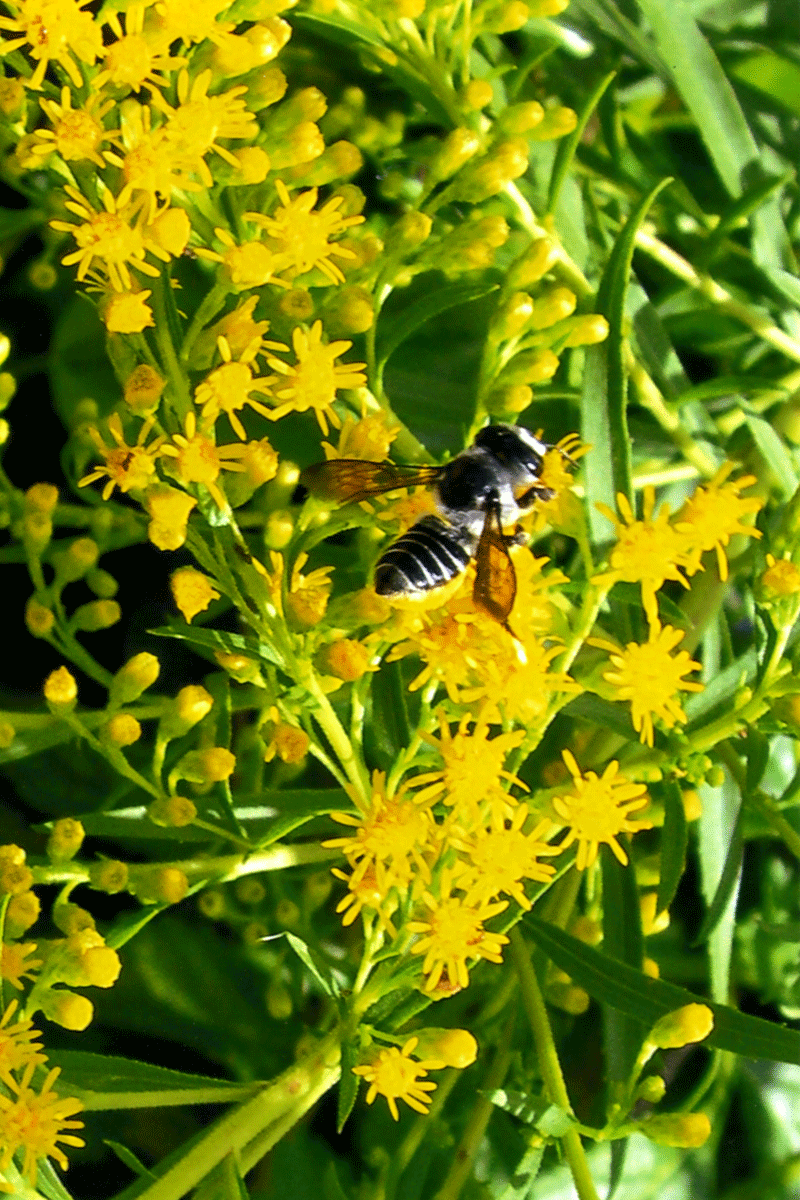
The Megachile bee is about the size of a honeybee. It does not sting unless provoked, and the sting is said to be less painful than that of a honeybee. It is somewhat chunky, with black and white bands on the abdomen and black on the upper thorax. Both sexes are generalist pollinators - they like just about everything. Only the female nests. Instead of packing pollen into leg pouches like honeybees, she carries it on the underside of her abdomen.


Megachile on Heliotropium polyphyllum 


She will nest in just about anything the right size and shape - oarlocks, unused hoses, rotten wood, hollow twigs, burrows, or manmade nesting boxes. In Florida the bees also like holes drilled in stucco for fastening hurricane shutters! Nests in underground burrows don't seem to be affected by short-term inundation, or by getting gradually filled in.

Once she has found a suitable nesting place, the female cuts a round bottom plug, and then builds up the chamber with overlapping oval pieces of leaf. She cuts  these sections out of leaf margins one at the time. She works smoothly and precisely, taking only a few seconds. She's so fast that you're lucky to catch her in action. She carries the leaf section slightly curved, under her abdomen, to her nest. I've timed a bee in action, from entrance to exit from burrow.  She takes 60 to 90 seconds to get the new leaf section in place.


Megachile Carrying Oval Leaf Section


When the chamber is complete she packs it with a mixture of nectar and chewed pollen, lays a single egg, and departs to cut the circular seal, or plug. This is when the closely related cuckoo bee. Coelioxys sp., may make her move. She crawls into the nest, and lays her egg, which will hatch and eat both pollen and competing larva.

The  Megachile bee makes a series of chambers, one atop the other. The resulting cylinder is said to resemble a cigar somewhat. It would have to be a cigar no bigger in diameter than a straw. I extracted one from an oarlock one year and kept it in a dish. After a month or so, a faint, persistent buzzing told me that something was happening, and sure enough, one bee, followed quickly by another, emerged. At this point I took the bees and the rest of the cylinder outside where they belonged.

Leaf cutter bees live only a few months. The female dies after she completes her egg-laying. The larva pupates and overwinters in the nest as an adult until it emerges in the spring.


Megachile on Goldenrod


If you're trying to grow a prize rose or dahlia for exhibition, the leaf cutter bee could be a nuisance. Otherwise, since they are solitary, not part of a colony, the damage they do is minimal, and I think just adds interest.

There is a wealth of information on the Internet about leaf cutter bees. The Honeybee Conservancy site has great info, pictures and video. Click the following link to get to the site. leaf cutter bee. The University of Florida also has a good article. Go to edis.ifas.ufl.edu/in619. Another of my favorite sites is from the BeeInformed organization. https://beeinformed.org/2014/07/30/alfalfa-leafcutter-bee-.


Megachile Work on Gopher Apple, Licania michauxii


Honeybees  have the reputation of being the best crop pollinators, but that is not necessarily the case. Our native bees are vital in the pollination of crops, ornamentals and our native flora. I don't know whether the one in my yard is a native or the imported alfalfa bee, but either way it is more than welcome.


Tuesday, October 9, 2018

Sedges and Swales


I have been weeding in the swale - a 12-15-foot wide area between the property line and the street. It is county right-of-way, but the homeowner has to "maintain" it, i.e. nothing over 18 inches tall. People with lawns generally just let the grass grow to the street, but there was no lawn when we bought the house - just rocks - and there's no lawn now because we went with mulch instead of grass. The swale itself is covered with coarse drainfield rock, and, lamentably, many weeds.

Swales are designed to collect and hold rainwater so it filters down through layers of sand and soil to the groundwater below instead of running directly into a body of water or open land. The  middle of the swale, the lowest point connected to our lot, retains some soil moisture even in the dry season. The rock also helps keep the underlying soil relatively cool and moist.

It's no accident that a lot of things want to grow here, especially since the swale is located under the utility lines and gets daily contributions from the birds. Years ago I planted the iris relative blue-eyed grass (Sisyrinchium angustifolium) along the property line, but it migrated to the swale, which it liked much better, and has flourished and multiplied ever since.


Blue-eyed Grass, Sisyrinchium angustifolium


But so have the weeds. In theory you should not pull weeds, because that further disperses their seeds. Cutting them back before they bloom or killing them with herbicide aren't always options for me here, because the grasses and grass-like weeds grow right next to, or even within clumps of the blue-eyed grass, so I end up teasing them out, one by one. It sometimes feels like weeding with tweezers. I just hope that by persevering I eventually will have a blue-eyed grass meadow.

The grasses and sedges are the most troublesome weeds in the swale. They often superficially resemble the blue-eyed grass, and as I mentioned, are competing for the same turf. I really have to pay attention so that I don't inadvertently yank out clumps of the good stuff.

 I decided to draw a few of them, and then id them - fat chance! The sedge family, Cyperaceae, contains at least 5,000 species, and the genus Carex, the "true" sedges, has over 2000 species. The study of sedges is so complex and specialized that it even has its own name - caricology.

With botanical drawing you sort of have to know what you are looking for before you go looking for it, and I didn't read anything on the sedges until after I had drawn them, so I didn't collect enough detail for anything certain. About all I knew was the mnemonic, "Sedges have edges." Members of the genera Carex and Cyperus both have 3-angled stems.

As far as I can tell, I didn't find any Carex species on this first go-round.

The plant below might be Cyperus surinamensis,  and then again, it might not be. If I've identified it correctly, it's native to Florida.


Cyperus surinamensis ? - Flatsedge


The same goes for the sketch below. I simply didn't collect enough information for an id. Just going by superficial resemblance the closest candidate so far would be Cyperus croceus, "Baldwin Flat Sedge." This species is also native to Florida, but whether it's the one below is an open question.


Cyprus croceus? - Baldwin Flat Sedge?


The black-and-white drawing below is a species of Kyllinga, an exotic weed. Due to close similarities, botanists have folded this genus into Cyperus, so newer descriptions would list it as Cyperus brevifolius. This paraticular species  grows in mats in the wettest part of the swale. It stays short, definitely under 6 inches tall, and usually much shorter.


Yellow Nut Sedge? and Green Kyllinga


I am most confident about my last sedge. I'm pretty sure it is Cyperus rotundus, "purple nut sedge,"  or "purple nut grass."This species is sometimes called the "worst weed in the world," because it is so hard to eradicate. Though it's not my most troublesome weed, I have to patrol for it least weekly, or it would take over. You have to pull it low to the ground, or else the top just breaks off, and the plant regenerates from the rhizome.  Sometimes, if the soil is loose enough I get a long piece of the rhizome, and as I pull out one plant, another, a few inches away, disappears underground and comes up with the first one - really cool when it happens. Kind of like a botanical magic trick. Plants that haven't bloomed yet make good compost.


Cyperus rotundus - "Purple  Nut Sedge"


Last but not least, in my first foray, is Fimbristylis, another genus in Cyperaceae. It sometimes is called "fimbry" or "fringe rush." I have several species in the yard. I don't know what the one below is. The Fimbrystilis in our yard are rather attractive. They grow in tidy, basal clumps, and their small, pale brown "heads," with a bluish fringe between scales are pretty. I tried leaving some in the swale, but it quickly got out of hand. I may pot some and place them in one of my bog gardens to see if they can be controlled.


Fimbristylis Species


I have yet another sedge in a vase, waiting for me to draw it. I don't know whether it is another species, or just an immature specimen. It's quite ornamental, actually. I have a sneaking suspicion that I am getting slightly hooked on the Cyperaceae family. There are many sedges available in the nursery trade, but mine are scarcely likely to be among them.