Tuesday, October 30, 2018

Leaf Cutter Bees

A week or so back I was delighted to see the chewed margins of this pipevine (Aristolochia sp) leaf. Chewing is usually cause for alarm in the garden, but in this case it is evidence of leaf cutter bee activity, something to be welcomed.


A Leaf Cutter Bee Was Here!


The species I see could well be native to Florida. It also could be Megachile rotunda, the "alfalfa bee," imported into the U. S. after the 1930's to: you guessed it! pollinate alfalfa fields. Honeybees are not efficient pollinators of alfalfa. This useful little critter has spread since then to much of the U.S.

The family of leaf cutter bees, Megachilidae, contains at least 2,000 species, and occurs virtually worldwide. Around 63 -75 species can be found in Florida alone. Another common leaf cutter bee, the "mason bee," Osmia sp., constructs its egg chambers with leaves and mud. Osmia bees are produced commercially and can be ordered over the Internet.

The Megachile bee is about the size of a honeybee. It does not sting unless provoked, and the sting is said to be less painful than that of a honeybee. It is somewhat chunky, with black and white bands on the abdomen and black on the upper thorax. Both sexes are generalist pollinators - they like just about everything. Only the female nests. Instead of packing pollen into leg pouches like honeybees, she carries it on the underside of her abdomen.


Megachile on Heliotropium polyphyllum 


She will nest in just about anything the right size and shape - oarlocks, unused hoses, rotten wood, hollow twigs, burrows, or manmade nesting boxes. In Florida the bees also like holes drilled in stucco for fastening hurricane shutters! Nests in underground burrows don't seem to be affected by short-term inundation, or by getting gradually filled in.

Once she has found a suitable nesting place, the female cuts a round bottom plug, and then builds up the chamber with overlapping oval pieces of leaf. She cuts  these sections out of leaf margins one at the time. She works smoothly and precisely, taking only a few seconds. She's so fast that you're lucky to catch her in action. She carries the leaf section slightly curved, under her abdomen, to her nest. I've timed a bee in action, from entrance to exit from burrow.  She takes 60 to 90 seconds to get the new leaf section in place.


Megachile Carrying Oval Leaf Section


When the chamber is complete she packs it with a mixture of nectar and chewed pollen, lays a single egg, and departs to cut the circular seal, or plug. This is when the closely related cuckoo bee. Coelioxys sp., may make her move. She crawls into the nest, and lays her egg, which will hatch and eat both pollen and competing larva.

The  Megachile bee makes a series of chambers, one atop the other. The resulting cylinder is said to resemble a cigar somewhat. It would have to be a cigar no bigger in diameter than a straw. I extracted one from an oarlock one year and kept it in a dish. After a month or so, a faint, persistent buzzing told me that something was happening, and sure enough, one bee, followed quickly by another, emerged. At this point I took the bees and the rest of the cylinder outside where they belonged.

Leaf cutter bees live only a few months. The female dies after she completes her egg-laying. The larva pupates and overwinters in the nest as an adult until it emerges in the spring.
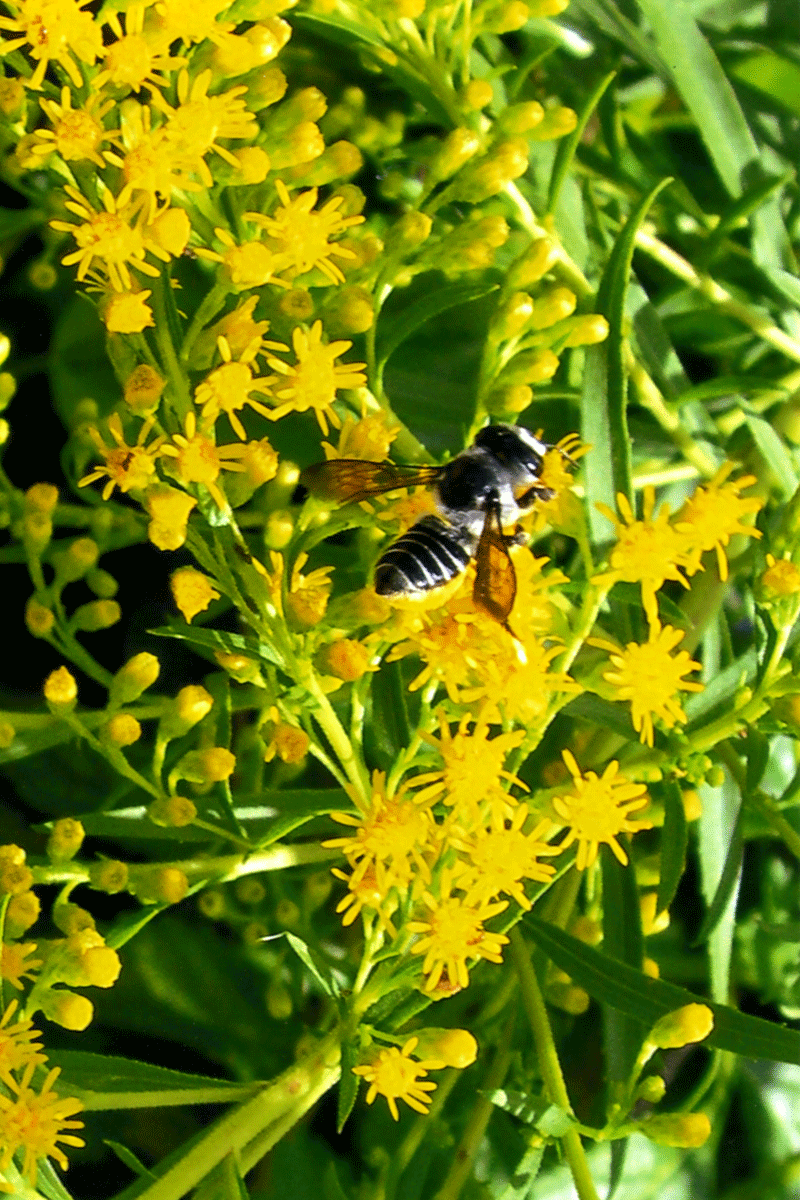


Megachile on Goldenrod


If you're trying to grow a prize rose or dahlia for exhibition, the leaf cutter bee could be a nuisance. Otherwise, since they are solitary, not part of a colony, the damage they do is minimal, and I think just adds interest.

There is a wealth of information on the Internet about leaf cutter bees. The Honeybee Conservancy site has great info, pictures and video. Click the following link to get to the site. leaf cutter bee. The University of Florida also has a good article. Go to edis.ifas.ufl.edu/in619. Another of my favorite sites is from the BeeInformed organization. https://beeinformed.org/2014/07/30/alfalfa-leafcutter-bee-.


Megachile Work on Gopher Apple, Licania michauxii


Honeybees  have the reputation of being the best crop pollinators, but that is not necessarily the case. Our native bees are vital in the pollination of crops, ornamentals and our native flora. I don't know whether the one in my yard is a native or the imported alfalfa bee, but either way it is more than welcome.


Tuesday, October 9, 2018

Sedges and Swales


I have been weeding in the swale - a 12-15-foot wide area between the property line and the street. It is county right-of-way, but the homeowner has to "maintain" it, i.e. nothing over 18 inches tall. People with lawns generally just let the grass grow to the street, but there was no lawn when we bought the house - just rocks - and there's no lawn now because we went with mulch instead of grass. The swale itself is covered with coarse drainfield rock, and, lamentably, many weeds.

Swales are designed to collect and hold rainwater so it filters down through layers of sand and soil to the groundwater below instead of running directly into a body of water or open land. The  middle of the swale, the lowest point connected to our lot, retains some soil moisture even in the dry season. The rock also helps keep the underlying soil relatively cool and moist.

It's no accident that a lot of things want to grow here, especially since the swale is located under the utility lines and gets daily contributions from the birds. Years ago I planted the iris relative blue-eyed grass (Sisyrinchium angustifolium) along the property line, but it migrated to the swale, which it liked much better, and has flourished and multiplied ever since.


Blue-eyed Grass, Sisyrinchium angustifolium


But so have the weeds. In theory you should not pull weeds, because that further disperses their seeds. Cutting them back before they bloom or killing them with herbicide aren't always options for me here, because the grasses and grass-like weeds grow right next to, or even within clumps of the blue-eyed grass, so I end up teasing them out, one by one. It sometimes feels like weeding with tweezers. I just hope that by persevering I eventually will have a blue-eyed grass meadow.

The grasses and sedges are the most troublesome weeds in the swale. They often superficially resemble the blue-eyed grass, and as I mentioned, are competing for the same turf. I really have to pay attention so that I don't inadvertently yank out clumps of the good stuff.

 I decided to draw a few of them, and then id them - fat chance! The sedge family, Cyperaceae, contains at least 5,000 species, and the genus Carex, the "true" sedges, has over 2000 species. The study of sedges is so complex and specialized that it even has its own name - caricology.

With botanical drawing you sort of have to know what you are looking for before you go looking for it, and I didn't read anything on the sedges until after I had drawn them, so I didn't collect enough detail for anything certain. About all I knew was the mnemonic, "Sedges have edges." Members of the genera Carex and Cyperus both have 3-angled stems.

As far as I can tell, I didn't find any Carex species on this first go-round.

The plant below might be Cyperus surinamensis,  and then again, it might not be. If I've identified it correctly, it's native to Florida.


Cyperus surinamensis ? - Flatsedge


The same goes for the sketch below. I simply didn't collect enough information for an id. Just going by superficial resemblance the closest candidate so far would be Cyperus croceus, "Baldwin Flat Sedge." This species is also native to Florida, but whether it's the one below is an open question.


Cyprus croceus? - Baldwin Flat Sedge?


The black-and-white drawing below is a species of Kyllinga, an exotic weed. Due to close similarities, botanists have folded this genus into Cyperus, so newer descriptions would list it as Cyperus brevifolius. This paraticular species  grows in mats in the wettest part of the swale. It stays short, definitely under 6 inches tall, and usually much shorter.


Yellow Nut Sedge? and Green Kyllinga


I am most confident about my last sedge. I'm pretty sure it is Cyperus rotundus, "purple nut sedge,"  or "purple nut grass."This species is sometimes called the "worst weed in the world," because it is so hard to eradicate. Though it's not my most troublesome weed, I have to patrol for it least weekly, or it would take over. You have to pull it low to the ground, or else the top just breaks off, and the plant regenerates from the rhizome.  Sometimes, if the soil is loose enough I get a long piece of the rhizome, and as I pull out one plant, another, a few inches away, disappears underground and comes up with the first one - really cool when it happens. Kind of like a botanical magic trick. Plants that haven't bloomed yet make good compost.


Cyperus rotundus - "Purple  Nut Sedge"


Last but not least, in my first foray, is Fimbristylis, another genus in Cyperaceae. It sometimes is called "fimbry" or "fringe rush." I have several species in the yard. I don't know what the one below is. The Fimbrystilis in our yard are rather attractive. They grow in tidy, basal clumps, and their small, pale brown "heads," with a bluish fringe between scales are pretty. I tried leaving some in the swale, but it quickly got out of hand. I may pot some and place them in one of my bog gardens to see if they can be controlled.


Fimbristylis Species


I have yet another sedge in a vase, waiting for me to draw it. I don't know whether it is another species, or just an immature specimen. It's quite ornamental, actually. I have a sneaking suspicion that I am getting slightly hooked on the Cyperaceae family. There are many sedges available in the nursery trade, but mine are scarcely likely to be among them.


Thursday, September 20, 2018

Little Daisy - Big Problem

A year or so ago I noticed a sprawling, low-growing aster relative cropping up here and there in the yard. I found it completely undistinguished and entirely without ornamental value, but I didn't make more than a half-hearted effort to get rid of it.

Like so many uninvited visitors, it has proven itself a very unwelcome guest in no hurry to leave. It has been beastly hot much of this summer, and I haven't been working in the yard as much as usual. I walked outside a few weeks back and discovered that this seemingly unassuming plant was in the process of overrunning the yard.

A quick ID session revealed it to be Tridax procumbens, or "coat buttons," a noxious weed if ever there were one. Originating in Central America, it has spread worldwide, and infests just about any location with a mild climate. It appears that the only places the weed has established itself in the United States are Florida, Puerto Rico ( I know it's a territory, not a state) and Hawaii, though there have been sporadic outbreaks in other states. However, if it is in north Florida and the Florida panhandle, it must be creeping into southern Georgia and Alabama by now.


Tridax procumbens, habit, ray floret, head


Tridax procumbens has opposite leaves which are arrow-shaped and deeply toothed. The margins (leaf edges) are fringed with tiny hairs. The top surface is felty dark green, with deeply impressed veins. If you bend a leaf to catch the light you will see glittering ranks of  short, stiff hairs that create a texture like fine-grit sandpaper.

The undersides of the leaves are a paler, grayish green with a less scabrous texture. The raised veins are very pronounced, and sport hairs of varying lengths.

The entire plant - leaves, petioles, stems, bases of the flower heads - is hairy. The stems are pale green shading into magenta-brown. The entire head is no bigger than a dime. It has numerous yellow disc flowers and a rather sparing ring of off-white or cream-colored ray florets ending in 3 teeth. (Hence the name "Tridax"). The heads produce thousands of achenes (seeds) whose chaff lets them float away on any breeze.


Leaves, Stems, Heads, Bristles


Triadax procumbens is on the Federal Noxious Weed List as well as the Noxious Weed List of the Florida Department of Agriculture and Consumer Services. It is also on Florida's Prohibited Aquatic and Wetland Plants List. My yard is dry and sandy, but the plant evidently thrives even more given moist conditions.

It's not altogether easy to weed, especially when it is intertwined with groundcovers. It's hard sometimes to find the central point from which the stems radiate outward, especially since the stems are brittle and break easily. You've got to get the taproot, though, or the thing will just regenerate.

In Florida it is illegal to possess, transport or sell "coat buttons." I don't know whether having an infestation on your property qualifies as "possession," but I wanted to be rid of it in any case. I bagged it and disposed of it in the garbage, not the yard waste. Better buried in the landfill than further distributed in county mulch. Though I've won the first round, I am sure I am not through with the war. There must be an established seed bank in the yard by now, and the source of the original contamination likely is still churning out the achenes.

Noxious or not, the plant has medicinal and pest-fighting qualities. It is used in indigenous medicine for a variety of ailments, including wound treatment, stopping bleeding, diarrhea, backache, bronchial congestion, and worms. Dried pulerized leaves and essential oils extracted from the leaves appear to provide some control against insects, nematodes and fungi. Though not native to India, it is used in Ayurvedic medicine. It also has cancer-fighting potential.

Monday, August 20, 2018

Summertime Blues 2 - Blue Butterflies

More summertime blues - (although they fly all year) - are tiny butterflies. The Cassius Blue and Ceraunus Blue butterflies breed in the yard, and it's possible that we have had visits from Eastern Pygmy Blues, since we are not far from the salt marshes where they and their larval plants thrive.

Generally the Florida Blues fly very close to the ground. Their flight is fast and erratic, and they don't seem to perch long enough for me to id them. Blink and you'll miss them. Their underwings are drab, and they fold their wings when perching. But you glimpse flashes of startling blue when they flutter to another spot.

They are tiny butterflies. The Ceraunus Blue has a maximum wingspan of  0.7 - 1.2 inches. The Cassius Blue is the same size or a little larger at the bottom range. The Eastern Pygmy Blue, one of the tiniest butterflies in the world, maxes out at  0.7 -0.9 inches.

They are among the "Gossamer-Winged" butterflies, and the delicate iridiscent blue of their upper wings makes that a very apt description. Black and white banded antennae are another characteristic of butterflies in this family, Lycaenidae, which also contains the Hairstreaks.


Ceraunus Blues and Neptunia pubescens


The Ceraunus Blue is quite common in Florida. It breeds as far north as central Florida, west to Texas and California, and south to Central America and the West Indies. Both males and females have one eyespot on each hindwing. The eyespot is quite prominent on the underside of the wing because it is large in relation to the size of the butterfly, and partially ringed with bright orange. Males are a shimmery true blue on top, while females are darker and can appear almost black.

Garden abundance of Ceraunus Blues is said to be low, but we seem to have a resident population. One of its larval host plants is Neptunia pubescens, "Tropical Puff" or "Yellow Puff."  We have a large clump or colony on one side of the driveway. This prostrate spreading legume has a delicate fern-like appearance due to its bipinnately compound leaves and tiny leaflets. When it thrives it arches and tumbles all over itself, and from a distance looks dense. However its fine texture does allow grasses, sedges and other weeds to invade it, so it requires a little maintenance - no water.

When it gets ratty looking I cut it back to the ground, and it regenerates beautifully. Indeed, care should be used in introducing it into the garden because it can be difficult to eradicate. Surrounded by concrete and brick, ours is pretty well neutralized, but I do need to trim it periodically to keep it out of the roadway. Neptunia is a "sensitive" plant, and the leaflets collapse as soon as they are touched - that poses some problems in drawing it!

The butterflies lay their eggs on the flower buds. The eggs, larvae and pupae are so tiny I've never been able to find even one. Neptunia flowers occur in "powder puff" heads, with bright yellow petals and numerous stamens. It doesn't produce enough flowers at one time to be truly showy, but evidently it flowers enough to sustain the Blues.

Perching Cassius Blues can be identified by the "zebra" striping on their underwings. This may be hard to see in my photo, but I can't enlarge it more without losing even more detail. They have 2 eyespots on the hindwing. Both sexes are blue on their topwings, though the female is paler wiith more brown than the male. This species is common throughout Florida, excluding the panhandle. They also range from south Texas, the West Indies, and south to Argentina.


Cassius Blue on Plumbago scandens


They lay their eggs on various legume and leadwort species. I used to have more of them because I grew the Florida native Plumbago scandens. This plant is problematic in the yard because it  resists training and scrambles over anything and everything in its path. Its small white flowers are attractive, but the buds and seed pods are extremely sticky, and if you or your pet gets them tangled in hair/fur, the only solution is to cut them out. I took out most of it, but one plant somehow escaped my grim reaping, so I am going to try once again to train, or at least contain it, just for the butterflies.

Milkpea (see my Jan.8, 18 post), a plant I vainly try to eradicate in the yard, is another larval host for Cassius and Ceraunus Blues. I called a temporary truce until  they had a chance to bring up a brood or two, but the milkpea is getting totally out of control in some places, so that's going to end soon.

Blues like to nectar on Phyla nodiflora, "Fogfruit," among other flowers. Phyla is also a magnet for the beautiful White Peacock butterfly, which uses it as a larval host. This plant, another member of the Verbena family so popular with pollinators, can be trained into a beautiful hanging basket. One of my brothers had a trick of looping the flower stalk around itself and then sliding it up quickly to pop off the head. He used to shoot the heads at me while we waited for the school bus. I tried, but never managed the snap.


Phyla nodiflora and Ceraunus Blue


Sources: Butterflies through Binoculars: A Field, Finding and Gardening Guide to Butterflies in Florida. Glassberg, Minno & Calhoun. Oxford U. Press, 2000. Plate 16 and facing page, pp. 78-81.

Florida Butterfly Gardening. Minno & Minno. U. Press of Florida, 1999. pp. 75-77.

Florida's Fabulous Butterflies. Emmel & Kenney. World Publications, 1997. pp. 18-19.


Monday, August 6, 2018

Weeds I Like IV - Spigelia anthelmia

I love the weed Spigelia anthelmia, "West Indian Pinkroot," for its combination of grace and energy. The arch of its stems and its dramatically veined leaves make it stand out, even in a sea of green. Some plants are taxing to draw, no matter how beautiful. But I always find great pleasure in sketching Spigelia, because I can have fun with it. It really lends itself to exuberant gesture drawings.


Spigelia anthelmia, West Indian Pinkroot


The pinkish tinge in the roots of the plant depicted above is a trick of my very inexpert Photoshop Elements editing. Otherwise I never have found anything evenly remotely pink about the roots of this plant. "Pinkroot" seems to be a frequent common name for plants in this genus, so I assume that the roots of at least one species are, indeed, pink.

The species epithet "anthelmia" indicates that this plant will kill worms, and it is used for that purpose where it is either native or naturalized. However, the leaves are highly toxic, so it's not anything for amateurs to try.  Spigelia anthelmia  is a component of several homeopathic remedies available on the Internet, and said to be useful in treating headache, migraine, nerve pain, sinus discomfort, constipation and indigestion, among other ailments.

The plant is native to Florida, the West Indies, and the New World tropics, and naturalized in many Old World tropical climates. It is a member of the family Loganiaceae, which also contains Gelsemium sempervirens, "Carolina or yellow jessamine," a beautiful but toxic vine native to much of the US, and the "strychnine tree," Strychnos nux-vomica, of India and SE Asia. Not a family you want to mess around with too casually!


Leaves and Flowering Spikes


Spigelia anthelmia can grow as an annual or perennial, and in our yard is most common in spring and summer. It likes moisture, and pops up most frequently in the gravel swale, the lowest, and hence, wettest part of the yard. The rock also keeps the roots cool. The swale is right under the utility lines, so all manner of interesting things can crop up there.


Pencil Sketch


This plant flowers, but its habit and foliage are the real attention-getters. Stems are upright, usually with some curvature, and topped with 2 pairs of dark green opposite leaves. One pair of leaves typically is larger than the other. The plant can reach 23 inches in height, but the ones in our yard are shorter. Leaves can be anything from 2 to 6 inches long, and three-quarters to 3 inches wide.

The top surface of the leaves is textured like fine-grit sandpaper. "Scabridulous" is a lovely botanical term for that. ( I tried to count the number of words in botanical Latin for varioius degrees and forms of hairness/thorniness, but there were so many that I gave up). The undersides of the leaves are smoother and paler green, with prominently raised veins. Stems may be single or several, branched or unbranched.

Flowering spikes emerge from the junction of the leaves, and produce flowers and seeds on one side only. The flowers open from the bottom up. They are very small, and white with maroon stripes. The petals are joined in the corolla tube. I think the flower buds resemble phillips-head screwdrivers. The flowers are only about 3/8 inch long, and about half as wide.


Spigelia anthelmia buds and immature seed pods


Open Flowers

The seed pods are warty, and turn gray brown when mature. Seeds are shiny and black, and are expelled with some force.

A relative, Spigelia marilandica, which has a much wider distribution in the US, is far showier. Its flowers are red with yellow interior, and also considerably larger. In Florida it occurs only in the panhandle.

Sunday, July 29, 2018

Summertime Blues I

Blues and purples have a calming effect in the garden, maybe because they suggest shadows and cool water. I have begun consolidating the blues scattered through our yard to maximize their impact - to create mini-oases amidst the reds, yellows, oranges and hot pinks that abound.


Waterlily "Tina"


The tropical waterlily Tina has been blooming like mad, in spite of the fact that I haven't fertilized it in over a year. "Her" pot is in a half-barrel nestled in the dappled shade of a Fiddlewood, one of the most valuable plants in the yard  because of the partial shade it affords.


A clump of chalky-blue Elliott's lovegrass has sprung up beside the waterlily pot, thriving from overspill. Grackles swoop down from the fiddlewood to bathe here because they can perch on the rim of of the pot within a pot, throwing out arcs of water with every wingflap. The grass loves it. I have the frame for an old hanging basket over the waterlily crown to keep them from destroying the plant, but when the grackles are active, I need to add water to the pot every day, and the grass gets a little drink in the process.


Elliott's Lovegrass in Bloom


Dwarf golden dewdrop, Duranta repens, is also good for cooling things down. Lucious racemes of white-edged, deep purple flowers droop from arching stems. I have to keep it in a pot to protect it from root knot nematodes, the bane of southern gardeners, and an especially bothersome pest in South Florida. If it is in full sun, the leaves get too yellow, so it needs some dappled shade to let the flowers and foliage thrive.


Golden Dewdrop


 Duranta used to be considered a Florida native, but isn't classified as such now. At any rate, it is certainly "Florida friendly" in terms of water and fertilizer usage. There is a non-dwarf form, but given the small size of the yard, I need to look for small varieties. The plant's name comes from the golden seeds (poisonous)  that follow the flowers. A member of the Verbena family, it is highly attractive to many butterflies. It blooms periodically throughout the year. I have moved its pot beside and a little in front of another Tina waterlily in the front yard. I like the effect of the branches drooping over the water, and I hope the purples will "talk" to each other.


Blue porterweed (Stachytarpheta jamaicensis), another member of Verbenaceae, would be my choice if I could have only one nectar plant. It attracts not only many butterflies and other insect species, but also hummingbirds. We see very few hummers, only during their spring and fall migrations, but they love the blue porterweed almost as much as the traditional red flowers like fire bush coral honeysuckle, and red geiger. (I remember hummingbirds nectaring at the blue balloon-flowers (Platycodon sp) I had in a rock garden in Georgia).


Native Blue Porterweed

It is hard to convey the beauty of blue porterweed in a photo or small drawing, since each flower spike has only 3-6 pale blue flowers open at a time. Each plant produces multiple spikes, though, so a mature plant, or even better, a clump of porterweeds, will have an abundance of blues dancing above the foliage.

There is a great deal of confusion in the trade over blue porterweed, and many nurseries unwittingly purvey a non-native form, Stachytarpheta urticifolia. This plant does attract butterflies, but also gets woody and scraggly with time. It has a minutely quilted leaf surface, and its flowers tend toward purple. The native porterweed has much smoother leaves, blue flowers, more compact habit, and smaller stature. Naturalist Roger Hammer has been instrumental in clearing up the confusion, at least within native plant circles.

I treat it as something like a long-lived annual or short-lived perennial. I cut it back when it starts to decline, but eventually it is easier for me to pull out the decadent individuals and foster the new ones that have sprung up in the yard. Without grass competition it self-sows actively, but not so much that it becomes a nuisance.


Carpenter Bee(?) on Native Blue Porterweed


Under very wet conditions the leaves may be attacked by a fungus. I have been able to keep this under control by pruning or removing diseased plants.  The porterweeds at a nearby nature center where I volunteered years ago were sometimes attacked by a stem-boring insect, but so far the ones in our yard have been free from this. They do get mealy bugs and spittle bugs, especially the older plants, but essentially are trouble free. They are growing scattered throughout the yard, and also in large pots.

Since we still have had no rain for over a week, fungus is the least of my worries. It rains all around us, and most days the skies get gray and even livid purple, with thunder and some lightning, but it passes us by with nary a sprinkle.


Friday, July 13, 2018

Sahara in South Florida?

June did not waste any time coming and going, and we're already pushing mid July.

Though it's been raining about a mile inland, we've been unusually dry here on the coast. The westerly seabreeze from the Gulf is keeping the summer storms from making it to us. According to our rain gauge, we got only 2.39 inches of rain in June, and most of that fell in one enormous thunderstorm. The rest of the rain fell in increments of a few hundredths of an inch, not enough to wet more than the very top layer of sand.

 So far in July, we've had 1.01," with little chancce of more before the end of next week. ( I have to be careful about what I wish for. I was lamenting the drought in May, and we ended up with over 15 inches here at the house). I save as much rainwater as I can, but I have containers for only 40-50 gallons, and I've used it all. I irrigate as little as possible, almost on a triage basis, but if this dry spell lingers too much longer I definitely will have to drag the hose around.


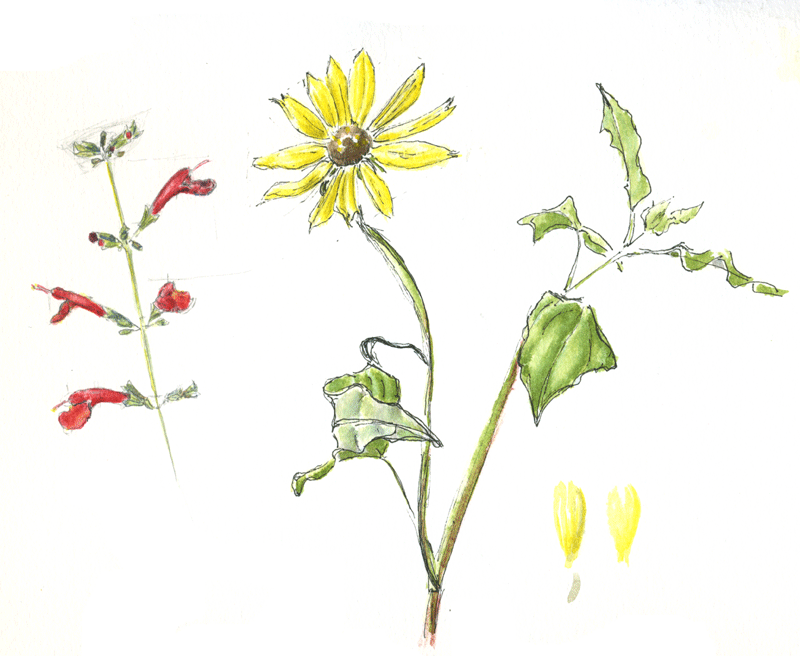
Dune Sunflower, Helianthus debilis, a semi-vining, scrambling beach native.  It takes  major drought to slow it down.


It's hot. Hot and humid, with heat indices in the 100's for most days. The whiteflies are going to town, and it's time to dispose of  expiring tomato and pepper plants. Native plants are far from immune, one reason I pulled out bushels of spent Gaillardias about a month ago. In Florida Weather, Morton D. Winsberg writes, "... air over Florida in summer becomes so humid that conditions are similar to those during rainy season in the Amazon or Congo basins." (p.94). By afternoon in summer our skies typically are hazy, even milky due to the humidity.


The weather may have been keeping me indoors for much of the day, but life in the garden continues at a frantic pace. The Lignum vitae, Guajacum sanctum, completed a glorious flush of blooms the last week of June. The blooming period is short - only about a week - but the intensely blue-to-violet flower petals are so gorgeous that I can't mourn the briefness of their stay. Besides, there will be more flushes as the year progresses.


Lignum vitae, Guajacum sanctum


This very slow-growing tree has shiny evergreen compound leaves and deeply textured grayish bark. It will grow tall and spindly in deep shade, but given more sun, it often develops a somewhat spreading habit. The trunk of the one in our yard is virtually prostrate. It had to grow out instead of up to get the light it craved, and two hurricanes enhanced the lean.  The plant definitely adds to the garden even out of bloom. Birds love to perch in it. The ornamental seed pods remind me of small golden turbans. They open to expose shiny black seeds covered with a fire-engine red flesh which mockingbirds and cardinals relish.


Open Seed Pods and Shiny Red Flesh Covering the Seeds


Since this tree has such a slow growth rate, it's not surprising that the wood is extremely tough. It is so heavy it won't float. The high resin content - about 30% - means that items made from the wood are self-lubricating, and it has been used for centuries, especially in shipping, for bearings and pulleys, and in food-handling machinery to avoid contamination. Gil Nelson writes, "Hinges made from lignum vitae served the locks of the Erie Canal for over 100 years." (The Shrubs and Woody Vines of Florida, p. 371).

 The resin gives it great tensile strength as well. Belaying pins, cricket balls, croquet mallets, British police truncheons, and mortars and pestles are some of the many other items made from this wood. Lignum vitae wood was used for the "aft main strut-bearings for the USS Nautilus," the first nuclear sub in the world. An item of trivia : images of the flowers, which are the state flowers of both Jamaica and the Bahamas, were embroidered in Meghan Markle's wedding veil. (Most of this information is from the Wikipedia article on Lignum vitae).


The discovery of the wood's qualities coupled with the fact that its sap could be used to treat symtoms of syphilis, meant that from the 1500's on, vast quantities were cut and shipped to Europe. This native of tropical America, from roughly northern South America to the Florida Keys, is now endangered. Fortunately it can be grown from seed, and grows well in cultivation. If you ever get the chance to visit Lignum Vitae Key State Botanical Park, don't miss it! Lignum vitae key has one of the very few, perhaps the only, virgin tropical hardwood hammock left in Florida.

Now, back to the Sahara. In spring, summer and early fall, vast clouds of dust from the Sahara desert collect in masses 1-2 miles deep, and 5,000 - 20,000 miles high in the atmosphere. These clouds of dust can be as large as the continental US. The Saharan Air Layer, as it is called consists of hot, very dry dusty air containing much mineral dust, and can be associated with strong winds. It tends to weaken or depress tropical storms, especially tropical cyclones moving across the Atlantic. (article by Jason Dunion. I can't get a direct link to the article to work, but you can find it on the NOAA website. In the search box type "Saharan Air Layer," and it should take you to the article). Because it blocks the sun's rays, it also diminishes local convective thunderstorms, which along with seabreeze collisions are a major source of Florida's summer rain. While the SAL is in place, we can pretty much forget about rain. I don't think the SAL extends much farther north than South Florida in the U.S., but I haven't been able to confirm that yet.

For a fascinating overview of the contents of Saharan dust, and the effects it has on the earth, including fertilizing the Amazon and sequestering carbon in the ocean, read Jason Adetunji's article, "What Dust from the Sahara Does to You and the Planet." (I can't get a link to work for this article either, but it appeared appeared in theconversation.com. You can find the article by entering the title in the search box).


The reddish soil in an agricultural area in Miami-Dade County known as the "Redlands" is possibly the result of tons of deposited Saharan dust, which contains iron particles.


Scarlet Sage and Dune Sunflower